The Number You Are Checking Against
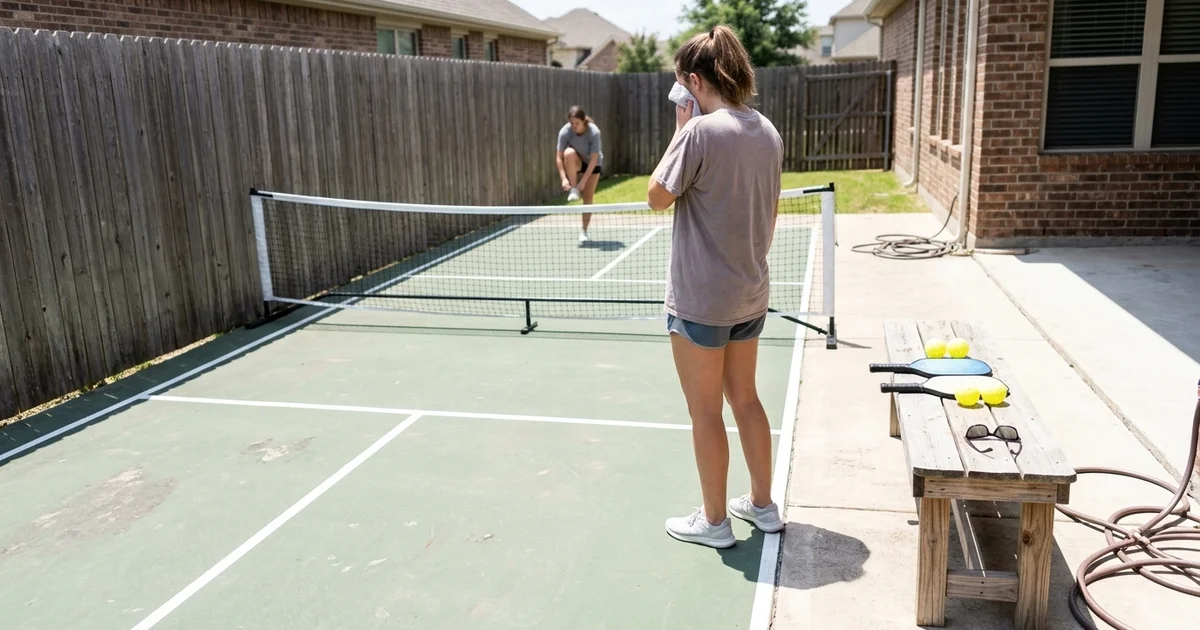
A regulation pickleball court has a 20 by 44 foot playing area, but the pad you need is bigger. Players run past the baseline and step outside the sidelines constantly, and a court poured right to the line is cramped and unsafe.
The recreational standard is a 30 by 60 foot pad, which gives roughly 8 feet behind each baseline and 5 feet along each sideline. That is what we build as standard in pickleball court construction across DFW.
So the first question is simple: is there a clear 30 by 60 foot area in your yard? If yes, you are very likely fine. If it is close, keep reading, because close is usually workable. The full set of regulation pickleball court dimensions covers where every one of those numbers comes from.
Why a Tape Measure Is Not the Whole Answer
Plenty of yards that measure big enough turn out not to be, and plenty that look marginal turn out to work. Three things decide it.
Setbacks. City rules determine how close a permanent structure can sit to a property line, and HOA covenants often add their own on top. This is the constraint that most often shrinks a workable area, and it does not show up when you pace the yard.
What is already there. Pool decks, mature tree canopy and root zones, septic fields, irrigation lines, drainage swales, and utility easements all shift where a slab can physically go.
Fall direction. Water has to leave the court and it has to leave in a direction that does not send it toward your house or a neighbour’s yard. On some lots this determines orientation before anything else does.
Four Moves for a Tight Lot
A marginal yard is not a no. These are the options we work through, roughly in order of how often they solve it.
Rotate the court. Orientation is frequently set by habit, square to the nearest fence. Turning the pad fifteen or twenty degrees can open up a diagonal that a square layout wastes entirely. We have fitted regulation pads into yards two other builders had already declined.
Trim one buffer. If one edge backs onto a fence rather than open yard, reducing the surround there while keeping it generous elsewhere is a fair trade. A 28 by 54 foot pad still delivers a full 20 by 44 playing area.
Move something else. A shed, a small planting bed, or a section of fence is often easier to relocate than people assume, and moving one of them can be the difference between cramped and comfortable.
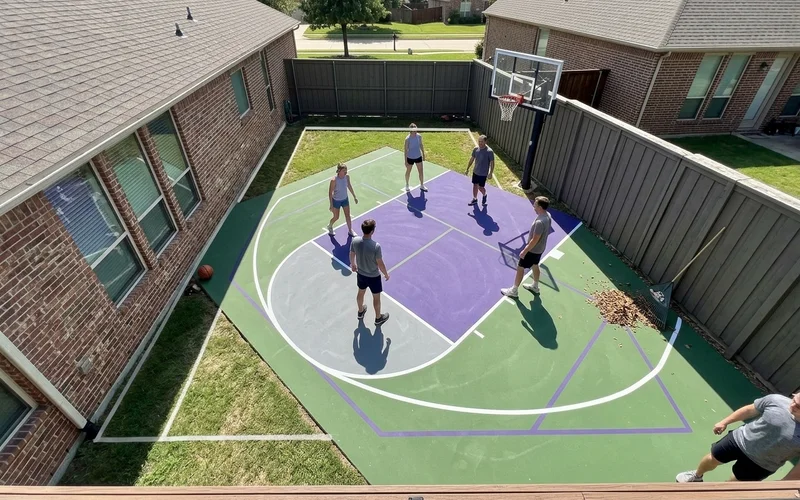
Change the layout. If a full pickleball court genuinely will not sit well, a multi-sport pad striped for basketball and pickleball, or a smaller dedicated layout, often delivers more usable play for the space you have.
Quick Self-Check
| Available clear area | Realistic outcome |
|---|---|
| 30 × 60 ft or more | Standard build, comfortable surrounds |
| 28 × 54 to 30 × 60 ft | Full play area, tighter buffer, still very playable |
| Under 28 × 54 ft | Consider rotation, a multi-sport pad, or a smaller layout |
| Irregular shape | Worth measuring, diagonal orientations often work |
Measure the clear area, not the whole yard. Exclude anything you are not willing to remove and anything a setback rules out.
What the Free Measurement Actually Does
The site visit takes about an hour and it answers the question properly rather than approximately.
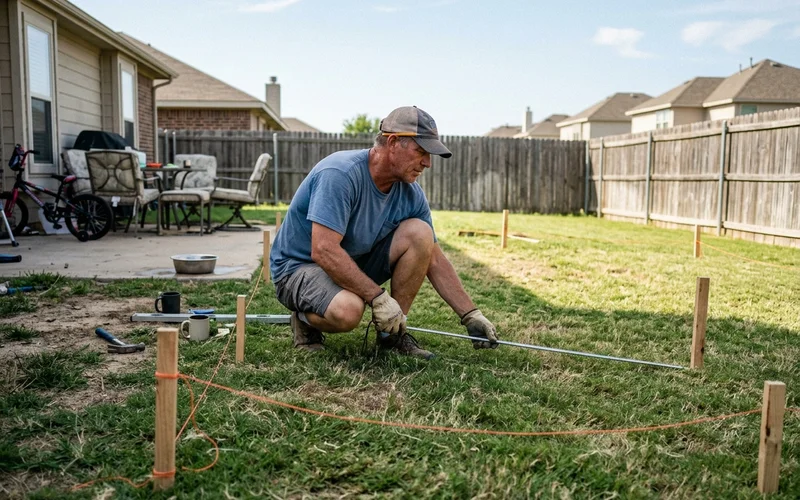
We measure the usable area, check the setbacks that apply to your specific address, look at fall direction and drainage, assess soil, and test orientation options on the ground with stakes. Then you see the result modelled in 3D on your actual lot, so you can judge how the court sits in the space before anything is committed.
If the answer is that a court does not work on your property, you will hear that. We would rather lose a project at the measuring stage than build something that never sat right in the yard. And if it does work, you leave with an accurate picture and a flat-rate quote.
You can book a free measurement whenever you want a definitive answer rather than an estimate from a satellite view.