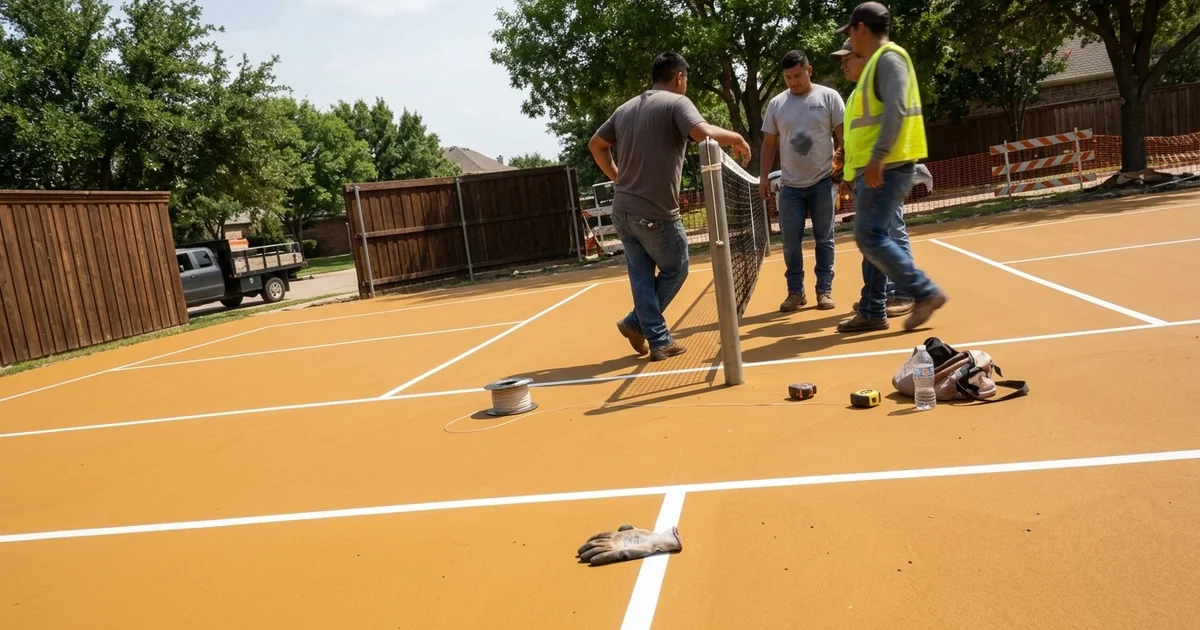
The Core Numbers
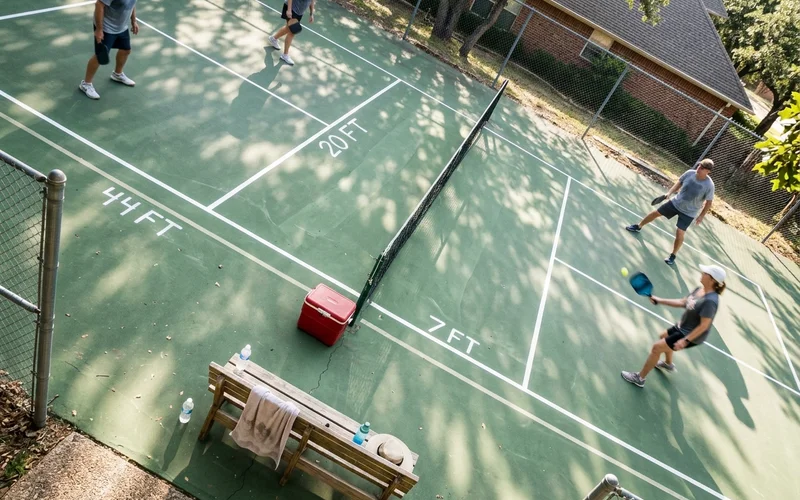
A regulation pickleball court, as defined by USA Pickleball, has a playing area of 20 feet wide by 44 feet long. That is the same footprint as a doubles badminton court, which is where the game’s dimensions originally came from.
Within that rectangle, the layout is straightforward:
- Non-volley zone (the kitchen): 7 feet from the net on each side, spanning the full 20-foot width
- Service courts: the area behind each kitchen line, divided down the middle into left and right service boxes
- Centreline: runs from the kitchen line to the baseline, splitting the service courts
- Baselines: the 20-foot lines at each end
- Sidelines: the 44-foot lines along each side
- Line width: 2 inches, with the outside edge forming the boundary
The same 20 by 44 dimensions apply to both singles and doubles. Unlike tennis, the court does not narrow for singles play. Only the service rules change.
Why the Pad Is Bigger Than the Court
This is the number people miss when planning a build, and it is the one that determines whether a court fits your property.
Nobody plays on a 20 by 44 foot slab. Players chase balls past the baseline and step outside the sidelines constantly, and a court poured right to the line leaves them running straight into a fence.
The recommended recreational footprint is 30 feet by 60 feet, which gives about 8 feet of run-off behind each baseline and 5 feet along each side. That is the pad size we build to as standard in our pickleball court construction, and it is what USA Pickleball recommends for general play.
Tournament venues go further, typically using a 34 by 64 foot surround so players have genuine room to run a wide ball down. On very tight residential lots we can sometimes work to around 28 by 54 feet, and the court is perfectly playable, though the surround is noticeably closer than a 30 by 60 build. If your yard is close to the line, whether a court fits your backyard comes down to setbacks and orientation more often than raw square footage.
| Measurement | Dimension |
|---|---|
| Playing area | 20 ft × 44 ft |
| Non-volley zone (each side) | 20 ft × 7 ft |
| Recommended pad | 30 ft × 60 ft |
| Tournament pad | 34 ft × 64 ft |
| Net height at posts | 36 inches |
| Net height at centre | 34 inches |
| Net post spacing | 22 ft (inside to inside) |
| Line width | 2 inches |
Net Height and the Centre Strap
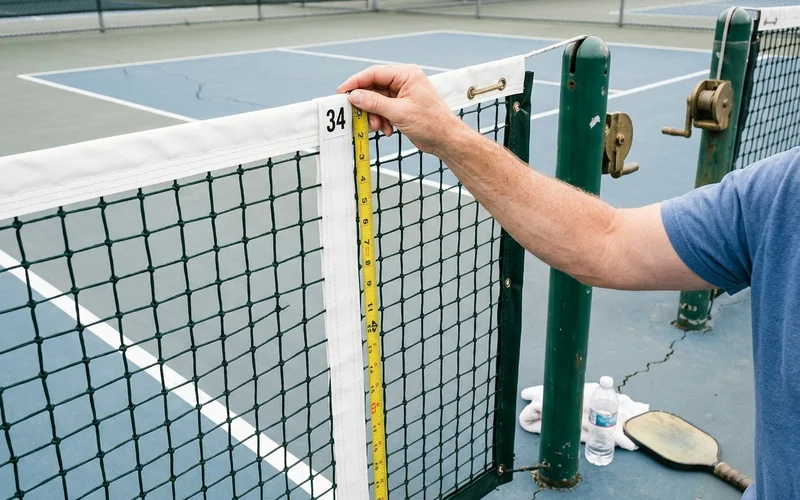
A regulation pickleball net is 36 inches high at the posts and 34 inches at the centre. The two-inch drop is deliberate, and it is not something the net does on its own.
Left unsupported, a tensioned net sags unevenly and the centre height drifts. A centre strap, anchored into the court surface at the midpoint, holds the net down to exactly 34 inches. That anchor is set flush into the slab, which is why it is far better cast during the original pour than drilled into cured concrete afterwards.
Posts sit 22 feet apart, inside edge to inside edge, placing them a foot clear of each sideline. On a properly built court the posts are set in their own concrete footings and fitted with an internal-wind brass tensioner, which keeps the net at correct height through a full season rather than sagging by midsummer.
The Kitchen Explained
The non-volley zone is the rule that makes pickleball pickleball, so it is worth understanding beyond the measurement.
It extends 7 feet from the net on both sides, across the full width. Within that zone you cannot volley the ball, meaning you cannot strike it out of the air. You may stand in the kitchen, and you may play a ball that has bounced there. What you cannot do is volley while any part of you is touching the zone, including its lines, and including momentum that carries you into it after the shot.
That single rule is what prevents the game from becoming a net-rush contest and why pickleball rewards placement over power. From a construction perspective it means the kitchen lines must be laid out precisely, because a kitchen that is six inches deep in the wrong direction changes how the whole game plays.
Orientation and Surrounds
Two more considerations do not appear in the official dimensions but matter in practice.
Orientation. A north-south alignment keeps the low morning and evening sun out of players’ eyes along the length of the court. Most backyard courts get used before work and after dinner, which is exactly when sun angle is worst.
Fencing. Ten-foot perimeter fencing is common, though eight feet works well on flat lots with generous surrounds. Fencing sits outside the pad, so add its footprint when you are checking whether the whole installation clears your setbacks.
Getting the dimensions right on paper is the easy part. Confirming they fit your specific lot, with its setbacks, slope, and existing features, is what an on-site measurement is for.