Two Genuinely Different Products
When you research pickleball court surfaces, two options dominate.
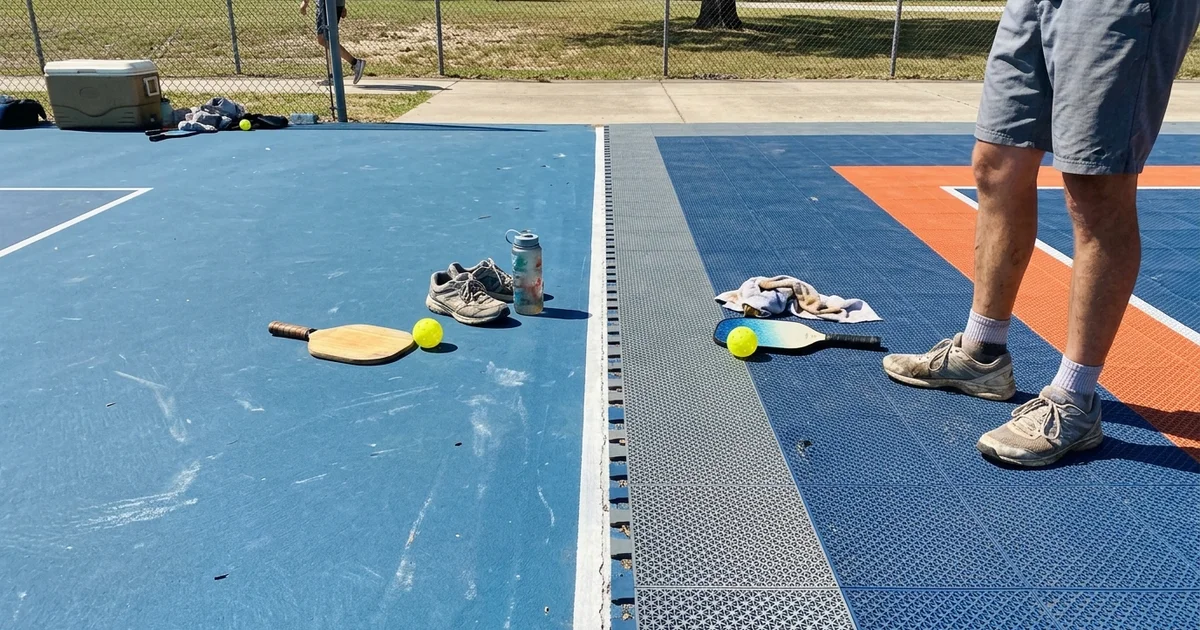
Acrylic on concrete. An engineered concrete slab finished with a multi-layer 100% acrylic system: adhesion promoter, resurfacer coats carrying graded silica sand for texture, colour coats, and regulation line paint. This is what professional and tournament venues use.
Modular interlocking tiles. Polypropylene tiles that snap together over an existing hard surface, usually a concrete slab or occasionally asphalt. They install quickly, come in a range of colours, and can be lifted and relaid.
Both produce playable pickleball courts. They behave differently, and in Texas specifically some of those differences are amplified, starting with the slab underneath — how courts are engineered for Texas clay soil decides how well either surface holds up.
Ball Bounce and Play Feel
This is where the gap is clearest.
Acrylic bonded to concrete is a monolithic surface. The ball meets the same material with the same backing everywhere on the court, which produces a consistent, predictable bounce. Every set of tournament standards is written around this surface.
Modular tiles introduce two variables. The tiles themselves flex slightly under load, which takes a small amount of pace off the ball and softens the bounce. And the joints between tiles are, by definition, not identical to the middle of a tile. A ball landing on a seam can behave marginally differently from one landing flat.
For casual family play this is a non-issue and plenty of people prefer the slightly softer feel underfoot. For anyone playing competitively or training for it, the consistency of acrylic on concrete is the reason it dominates serious venues.
Heat and Thermal Expansion
Both surfaces get hot in a Texas summer. Tile manufacturers point out that air circulates beneath their product, which does help surface temperature somewhat, and that is a fair claim.
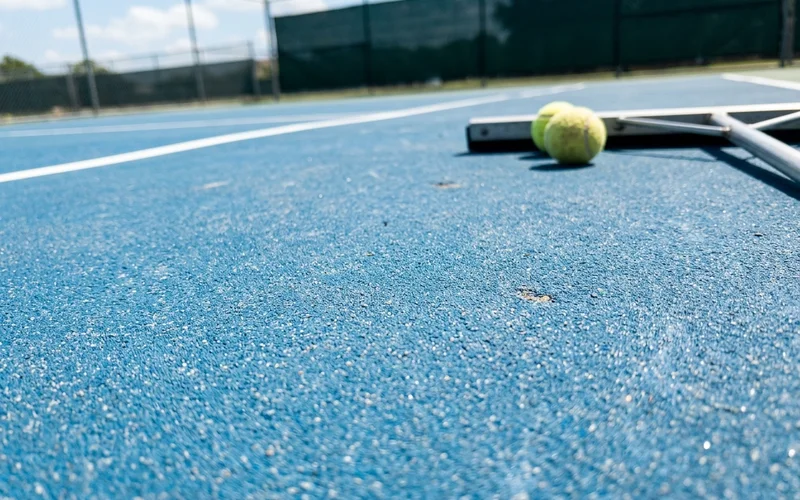
The more consequential heat issue is thermal expansion. North Texas swings from below freezing in January to well over 100 degrees in August. Polypropylene expands and contracts substantially across that range, and a tiled court is thousands of individual pieces all doing it at once.
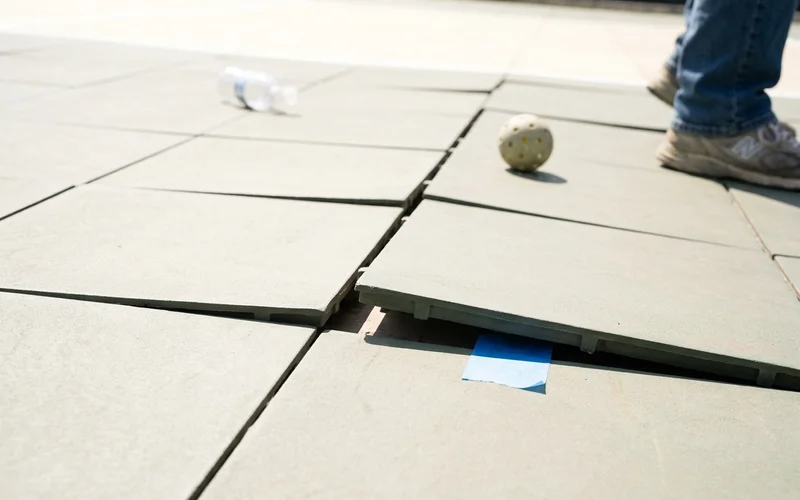
Properly installed systems account for this with expansion allowance at the perimeter. Where that allowance is inadequate, or where the installation was tight, the result over several seasons is gapping at joints, buckling in the middle of the court, or lifting at edges. Individual tiles can be replaced, which is a genuine advantage of the system, but it is maintenance a monolithic surface does not require.
Acrylic on concrete has its own thermal behaviour, managed through the slab’s expansion joints and the flexibility of the acrylic system itself. On a properly engineered slab it is not a maintenance item.
Traction and Safety
Acrylic texture is engineered. The silica sand grading in the resurfacer coats determines exactly how much grip the surface offers, and it is chosen to sit between two failure modes: too slick and players slide on a hard cut, too coarse and a fall removes skin.
Tile traction comes from the moulded surface pattern. It works, and it drains quickly because water passes through the tile perforations. What it does not offer is the same ability to tune grip to the sport and the player.
Both surfaces get slippery when contaminated with algae or organic debris, which is a maintenance question rather than a product question.
Cost Over Time
This is where the comparison gets misread most often.
| Factor | Acrylic on concrete | Modular tiles |
|---|---|---|
| Upfront cost | Higher (includes engineered slab) | Lower if a sound slab exists |
| Base required | Engineered post-tension slab | Existing hard surface |
| Renewal cycle | Resurface every 6–10 years | Replace tiles as they fail |
| Renewal cost | Moderate | Varies with failure rate |
| Bounce consistency | Highest | Good, with joint variation |
| Heat behaviour | Stable | Expansion and contraction at joints |
| Repair | Patch and resurface | Swap individual tiles |
| Typical service life | Slab decades, surface renewed | Shorter full replacement cycle |
Tiles frequently look cheaper because the comparison is made against a full new build. That is not the same comparison. If you already have a sound slab, tiles versus acrylic resurfacing is a fair contest, and tiles can win on speed and on the ability to change colours later.
If you do not have a slab, you need one either way. Laying tiles over compacted soil or a thin unengineered pad in Blackland Prairie clay produces the worst outcome of all, because the base moves and the tiles simply follow it.
What We Build and Why
We build acrylic on engineered post-tension concrete, and our reasoning is specific to this region.
North Texas clay demands a properly engineered slab regardless of what surface goes on top. Once you have made that investment, the marginal cost of finishing it with a full acrylic system rather than tiles is modest, and you get tournament-consistent play, tuned traction, and a surface that renews for a fraction of its original cost every six to ten years. You can see the full build specification on our pickleball court construction page.
Where tiles genuinely make sense is over a sound existing slab where you want a fast, colourful refresh, or where you may want to relocate or reconfigure the court later. Those are real use cases and we will say so if they describe your situation.
What we would steer anyone away from is treating tiles as a way to skip the foundation. In this soil, the foundation is the part you cannot shortcut.