The Ground You Are Building On
North Texas sits on Blackland Prairie clay. It is dark, fertile, agriculturally excellent soil, and it is among the most expansive in the United States.
Expansive means the clay changes volume with moisture. It absorbs water and swells; it dries out and contracts. The plasticity index, which measures how much a soil does this, is high here. In practical terms the ground beneath your yard moves measurably across a season, rising through wet springs and dropping through drought summers.
Crucially, it does not move uniformly. Soil under a tree canopy dries faster than soil in the open. Soil beside an irrigated bed stays wetter than soil at the far corner. Under a single slab you can have one edge rising while the opposite edge falls.
Concrete handles compression extremely well and tension poorly. Differential soil movement puts a slab into tension across the span between the high point and the low point. That tension is what cracks courts, and it is why a foundation designed for stable soil fails here within a few seasons. It is also the largest single line item in what a pickleball court costs in Texas, and the one part you cannot renew later.
Step One: The Sub-Base
The foundation work starts before any concrete exists.
We excavate to depth, removing topsoil and any loose or organic material, then lay and compact crushed aggregate to a specified thickness. This does two jobs. It gives the slab uniform bearing support, so it is not sitting directly on native clay whose behaviour varies from one metre to the next. And it creates a drainage layer beneath the slab, so water that does reach that level has somewhere to go.
Compaction is tested rather than assumed. A poorly compacted base settles unevenly, and no amount of good concrete above it fixes that.
Step Two: Vapour Barrier and Moisture Mitigation
A vapour barrier goes down over the compacted base before the pour. It limits moisture migration from the soil into the underside of the slab.
In expansive clay, controlling moisture is half of the structural problem. Every measure that reduces how much the soil moisture beneath a slab swings is a measure that reduces how much the soil moves, and therefore how much force the slab has to resist.
Step Three: Post-Tension Tendons and the Grade Beam
This is the part that distinguishes a court built for this soil from one built anywhere else, and it is the specification behind all of our pickleball court construction.
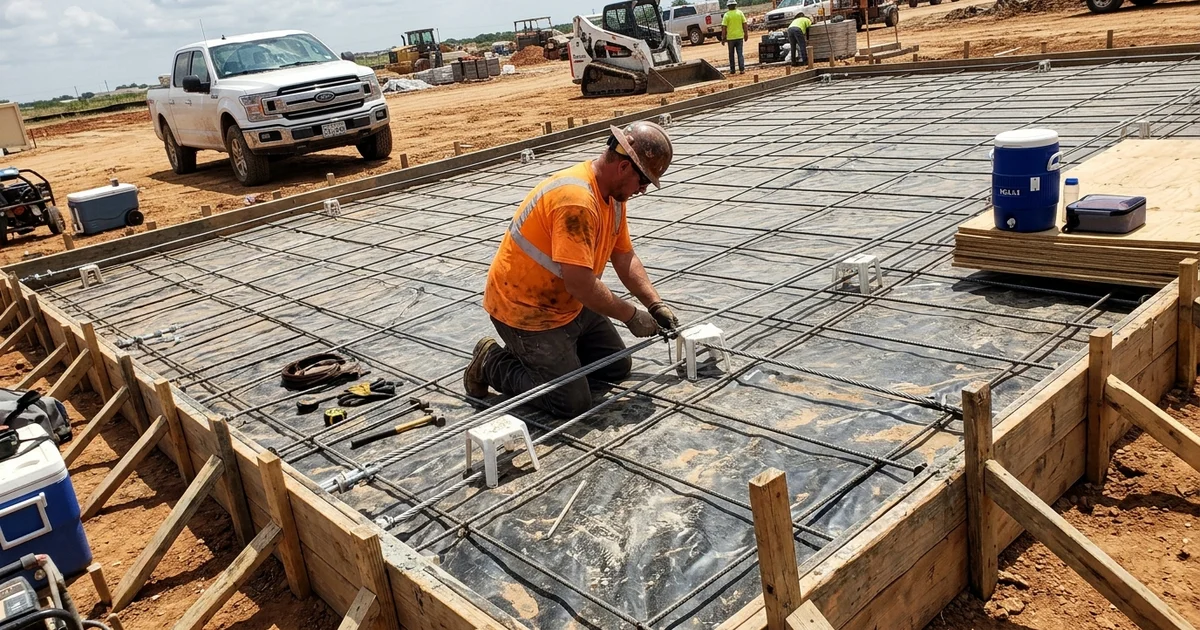
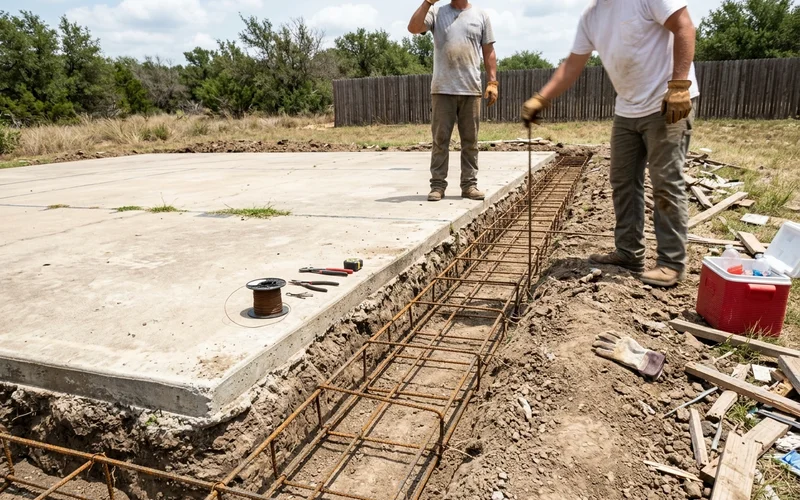
Steel tendons, sheathed in plastic and greased so they can move within the concrete, are laid in a grid across the slab area before the pour. Around the perimeter we form a thickened, reinforced grade beam, which stiffens the slab edge where the moisture swing is largest.
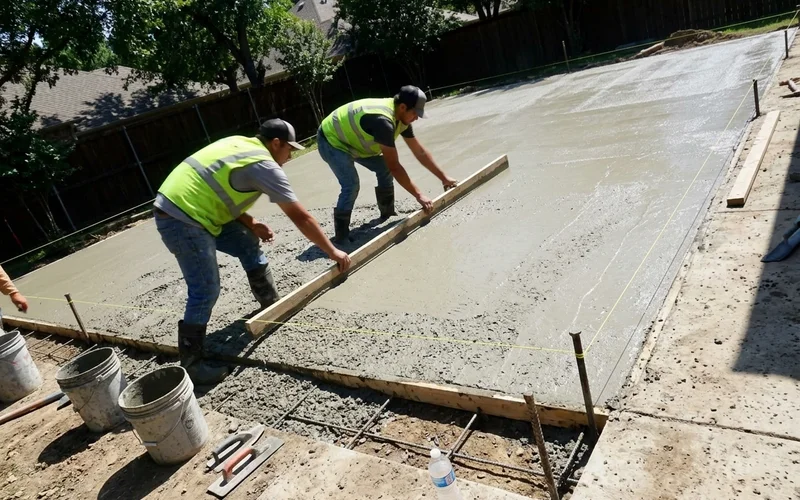
The concrete is poured as a single monolithic slab, screeded to the drainage slope, and left to cure. Once it reaches a specified strength, usually a few days later, each tendon is stressed with a hydraulic jack to a calculated force and locked off at its anchorage.
We measure the elongation of every tendon during stressing and record it. If a cable does not stretch the predicted amount, it has not reached design force, and that gets investigated rather than accepted. It is the difference between a slab that is engineered and a slab that is assumed.
The result is a slab held permanently in compression. When the soil beneath it moves, the slab has a reservoir of compression to absorb that tension before any part of it goes into net tension. It rides the movement as one unit instead of splitting along a weak line.
Step Four: The Drainage Plane
While the concrete is still workable, the crew screeds it to a continuous 1% slope. One plane, one direction, established with string lines set before the forms went in.
The obvious benefit is playability. Water sheets off a sloped court in minutes instead of ponding for two days.
The structural benefit is less obvious and more important. A puddle sitting on a court keeps the soil beneath that area saturated while the rest of the pad dries out. That is a moisture differential, created by the court itself, and moisture differential is exactly the condition that drives differential soil movement. A court that drains properly puts less stress into its own foundation.
How the Layers Work Together
| Layer | Purpose |
|---|---|
| Compacted aggregate sub-base | Uniform bearing, sub-slab drainage |
| Vapour barrier | Limits moisture migration into the slab |
| Post-tension tendon grid | Holds the slab in compression |
| Perimeter grade beam | Stiffens the edge against moisture swing |
| 1% continuous slope | Sheds surface water, reduces moisture differential |
| 7-layer acrylic system | Wearing surface, texture, colour, UV resistance |
No single layer does the job alone. A post-tension slab on a poorly compacted base still settles. A perfectly engineered slab with flat drainage still creates its own moisture problem. The system works because each element removes one of the ways this soil defeats concrete.
Why the Cheaper Quote Is Not Cheaper
A conventional rebar-reinforced slab is faster and less expensive to build. In stable soil it is a perfectly reasonable specification.
In Blackland Prairie clay it is a deferred cost. The most common repair enquiry we receive is a cracked court built five to eight years ago on a conventional slab, and once a slab has split structurally, resurfacing is putting good money over a failing base. The fix is a rebuild.
Everything above a court slab can be renewed. The acrylic surface, the striping, the nets, the fencing, all of it has a maintenance cycle and can be refreshed. The slab is the one decision you make once.