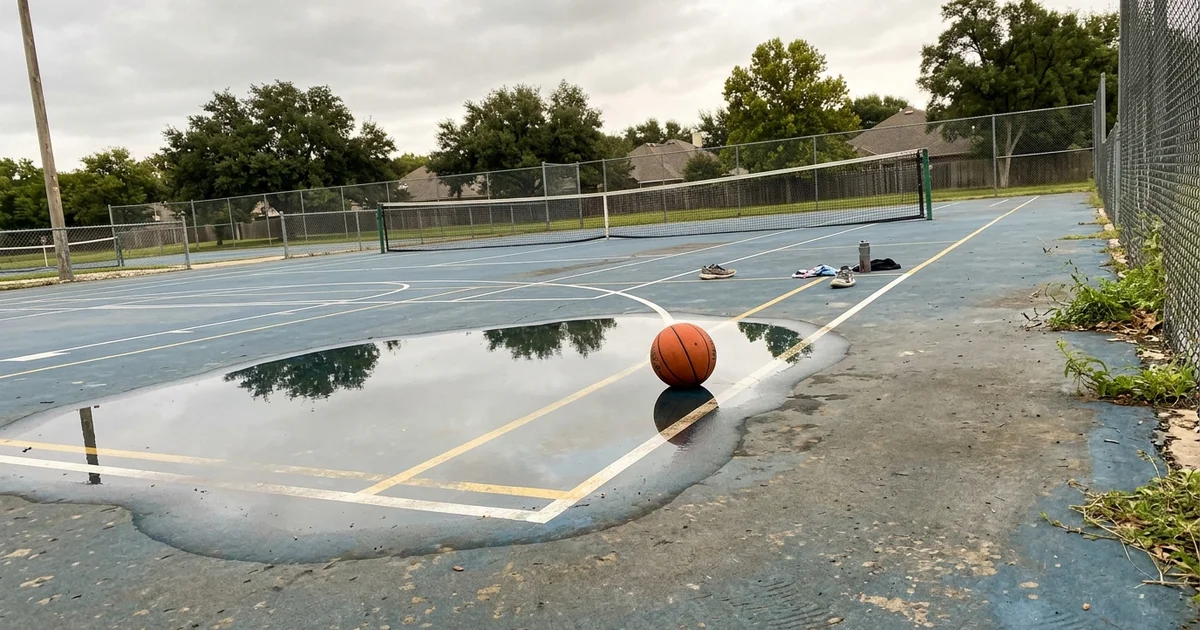
Water on a Court Is a Symptom, Not the Problem
Standing water after rain is the most visible court fault there is, and it almost always points to one of three underlying causes. Identifying which one you have determines whether the fix is a few days of work or a rebuild.
Inadequate original slope. The court was poured too flat, or sloped in more than one direction. This is common on older courts and on courts built by contractors without sport-specific experience.
Localised low spots. The slope is broadly correct, but wear, settlement, or an uneven original finish has created shallow depressions that hold water. These are the classic birdbaths.
Blocked or failed perimeter drainage. The court sheds water correctly, but the channel, swale, or discharge point around it has silted up, been covered by landscaping, or was never adequate. Water leaves the court and then comes straight back.
Slab movement. The serious one. The slab itself has settled or tilted, changing the drainage direction. This is a structural problem and no amount of surface work corrects it, and it usually shows up alongside cracking that runs through the full slab depth.
The Nickel Test
The industry has a simple, measurable tolerance for this, and it is worth knowing because you can check it yourself.
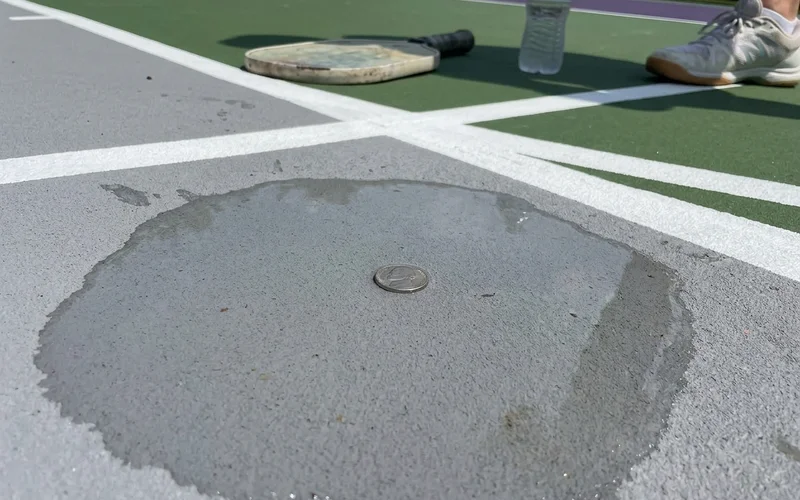
After rain, or after flooding the court with a hose, no remaining puddle should be deeper than a nickel laid flat, which is roughly one sixteenth of an inch. If you can lay a nickel in a puddle and it disappears under the water, that area needs levelling.
This is the standard we work to on every levelling job, and it is the standard we test against before we call the work finished. It is objective, it is repeatable, and you can verify it yourself after we leave.
Why Pooling Matters Beyond Playability
The obvious cost of pooling is a court you cannot use for two days after a storm. There are three less obvious ones.
Surface degradation. Standing water breaks down acrylic coatings over time, and the affected areas lose colour and texture faster than the rest of the court.
Algae and traction loss. Persistent damp grows algae, which makes a surface genuinely slippery. This is a safety issue more than a cosmetic one.
Soil moisture differential. This is the one nobody thinks about. A puddle sitting on a court keeps the soil beneath that area saturated while the rest of the pad dries out. In Blackland Prairie clay, differential moisture is exactly what drives differential soil movement, which is what cracks slabs. A court that ponds is quietly working against its own foundation.
How Levelling Works
The process is straightforward and the preparation is most of it.
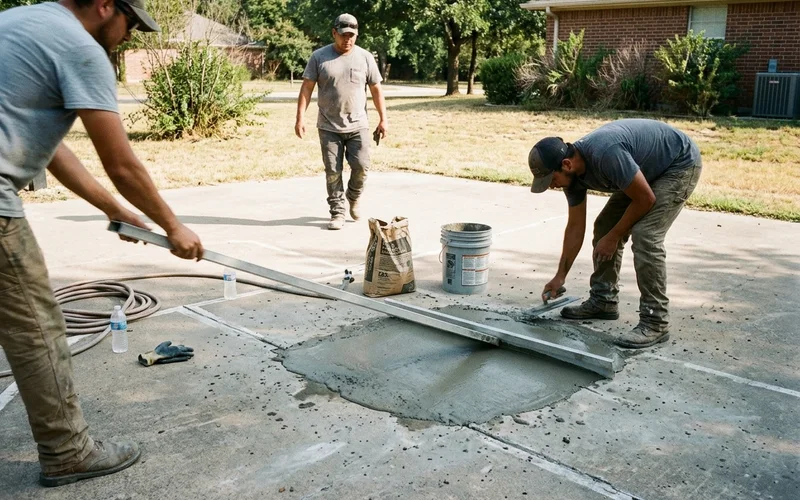
We flood the court and mark every low spot while the water is still standing, because reading levels on a dry surface misses shallow depressions that nonetheless hold water. Those marks become the map.
The surface is cleaned and prepared so the levelling compound bonds properly. Then the compound is applied and screeded out from the centre of each low spot, feathered to nothing at the edges so there is no lip or ridge. Deeper birdbaths need more than one application with cure time between.
Once cured, we flood the court again and check against the nickel test. Any area that still fails gets another pass.
Levelling is almost always done as part of a resurface rather than on its own, because the acrylic system goes on over the corrected surface and the whole court ends up with consistent texture and colour.
When Re-Sloping or a Rebuild Is Needed
| Symptom | Likely cause | Fix |
|---|---|---|
| Isolated shallow puddles | Localised low spots | Levelling compound, resurface |
| Water along one line or edge | Original slope inadequate | Levelling, partial re-slope |
| Water after every storm across a wide area | Slope wrong or blocked drainage | Re-slope and drainage correction |
| Water plus cracking with height differences | Slab has moved | Rebuild on engineered slab |
Re-sloping during a resurface can correct moderate slope problems by building up material across one area, though there is a practical limit to how much you can add before the surface becomes too thick and the transitions too obvious.
Where the ponding comes from the slab having genuinely tilted or settled, we will tell you that a rebuild on an engineered post-tension slab is the honest answer. Correcting the surface over a slab that is still moving means doing it again in a few years.
Preventing It on a New Court
Every court we build is set to a continuous 1% slope drainage plane, established with string lines before the forms go in, running as a single unbroken plane across the whole pad. Combined with proper perimeter drainage and a post-tension slab that does not settle differentially, that is what keeps a court dry.
If your existing court ponds, the assessment is free and it will tell you which category you are in. You can read more about our approach to court resurfacing and repair, or get a free assessment and find out what is actually happening.