Two Systems, One Question
Every acrylic court surface is a layered system built up over a prepared concrete slab. The difference between standard and cushioned comes down to what sits between the slab and the colour coats.
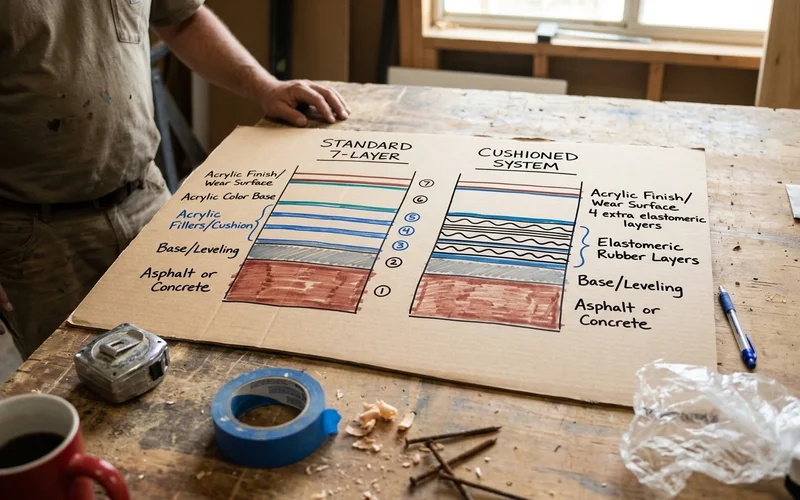
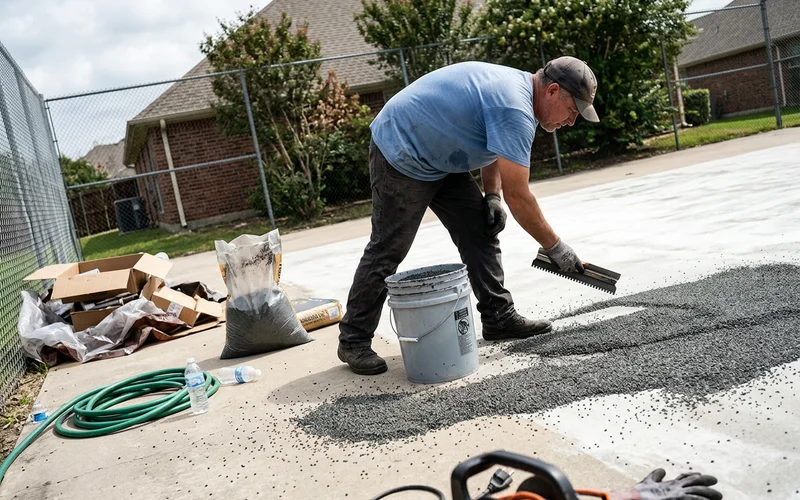
Standard seven-layer acrylic. Adhesion promoter, acrylic resurfacer coats carrying graded silica sand for texture, colour coats, and line paint. This is what we install as standard and what the majority of courts use.
Cushioned acrylic. The same system with additional elastomeric layers beneath the colour coats, typically rubber granules bound in acrylic, laid in several passes. The colour and texture on top are identical; what changes is what happens underfoot.
The question is whether the additional comfort justifies the additional cost for how you actually play. Either system renews on the same schedule, so the choice also shapes what regular court washing and maintenance is protecting.
What Cushioning Actually Does
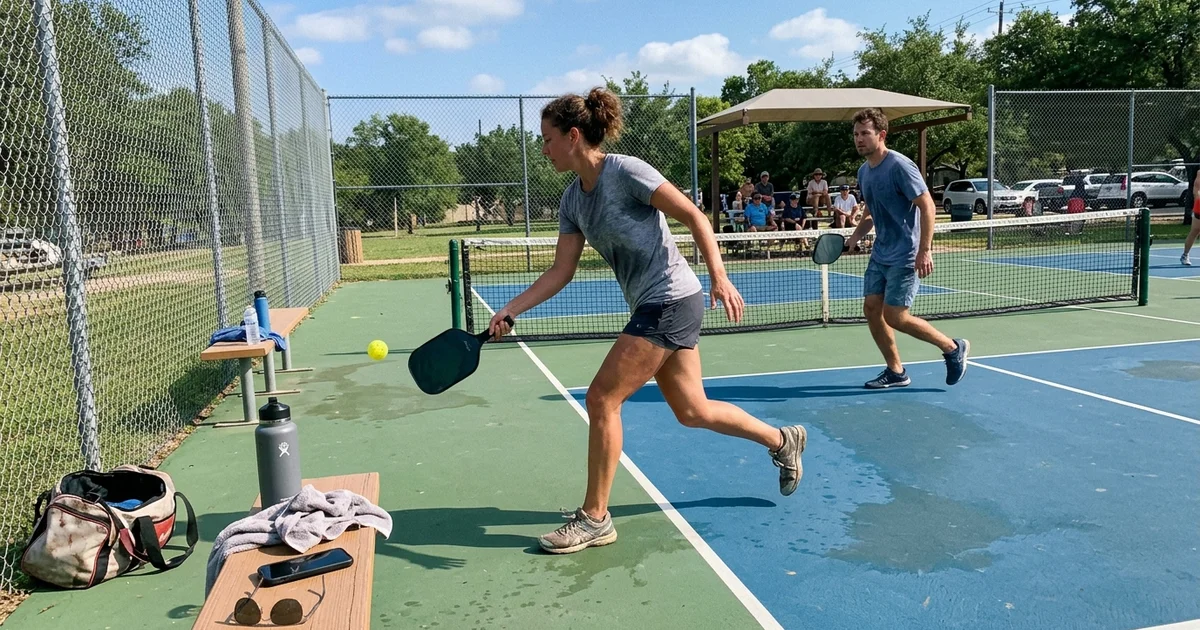
Hard courts are hard. Concrete with a thin acrylic coating transmits essentially all of the impact from every step, stop, and landing straight into your joints.
Elastomeric layers absorb a portion of that. The effect on any single step is small. The effect across a two-hour session, several times a week, across a season, is not.
Players who make the switch consistently report the same two things: less soreness the day after, and being able to play longer before fatigue sets in. Neither shows up in a single game, which is exactly why cushioning is a poor investment for someone who plays once a fortnight and a good one for someone on court four times a week.
There is a secondary benefit worth mentioning. A cushioned surface is more forgiving in a fall, which matters on courts used by children or older players.
The Trade-Offs
Ball speed and bounce. A cushioned surface plays marginally slower with a slightly softer bounce. Systems are specified to stay within normal playing characteristics, so the difference is perceptible to a regular player and usually not to a casual one. Competitive players sometimes prefer the pace of a standard surface and sometimes prefer the comfort of cushion; it is genuinely a matter of preference.
Cost. The elastomeric layers add material and installation labour, producing a meaningful premium over a standard system. That premium applies at every resurface, not only the first installation.
Installation sensitivity. Cushion layers demand correct surface preparation. Applied over an inadequately prepared or contaminated slab they are more prone to delamination than a thinner standard system would be. This is not a reason to avoid them; it is a reason to care who installs them.
Side by Side
| Factor | Standard acrylic | Cushioned acrylic |
|---|---|---|
| Layers | 7-layer build-up | 7-layer plus elastomeric layers |
| Feel underfoot | Firm | Noticeably softer |
| Joint impact | Full | Reduced |
| Ball pace | Standard | Marginally slower |
| Cost | Baseline | Meaningful premium |
| Renewal cycle | 6–10 years | Broadly similar |
| Best for | Occasional and casual play | Frequent play, older players, competitive use |
| Fall forgiveness | Standard | Better |
Who We Recommend It To
Yes, generally. Households where someone plays three or more times a week. Players over about fifty, or anyone with existing knee, hip, or back concerns. Courts that will host regular coaching or league play. Facilities where a wide age range uses the court.
Probably not. Households where the court will see occasional weekend use. Projects where the budget is better spent on lighting, which does more for how often the court gets used than comfort does for a light user.
Worth a conversation. Community and HOA facilities, where the calculation depends on whether the demographic skews toward older residents and on how heavily the courts will be used.
Timing the Decision
If you are building a new court, the cushion decision is made at design stage and the layers go on as part of the original surfacing.
If you have an existing court, a resurface is exactly the right moment. The old surface is being prepared regardless, so the incremental work is adding the elastomeric layers before the colour coats. Doing it as a standalone project later means paying for surface preparation twice.
If you are undecided on a new build, the standard system is the safe default. Cushioning can be added at the first resurface once you know how the court actually gets used, which for many households turns out to be different from what they expected.
Either way the slab underneath is identical: an engineered post-tension slab with a continuous drainage plane, because surface choice does not change what North Texas clay demands. You can read about the full surfacing process on our court resurfacing and repair page.