The Question Is About the Slab, Not the Surface
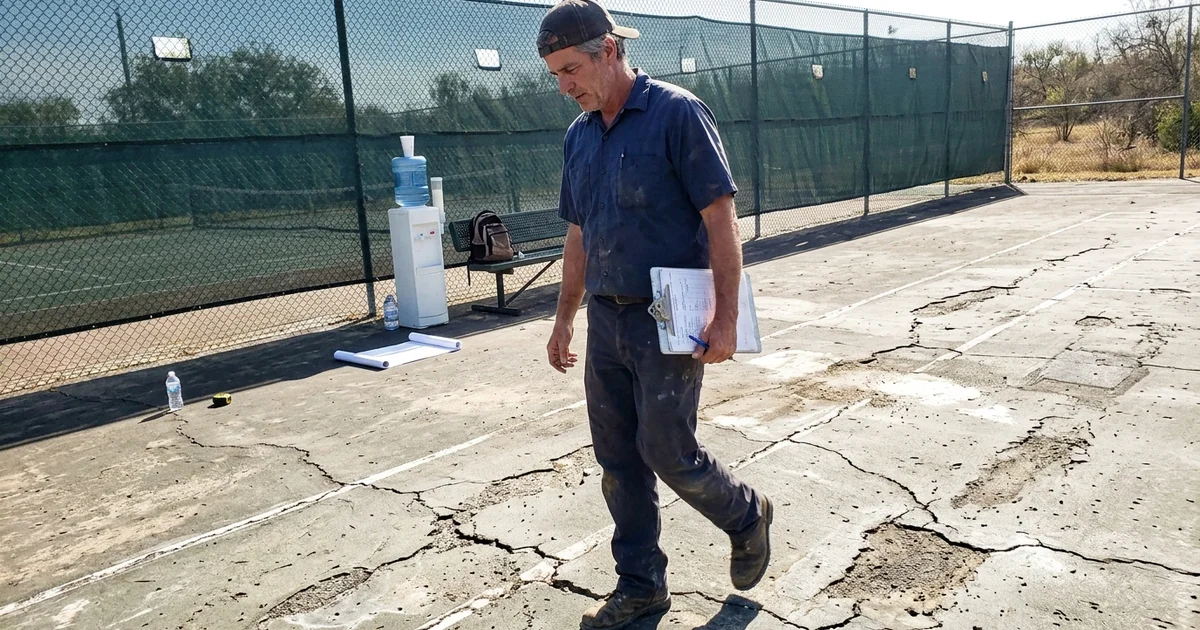
Everything hinges on one thing: whether the concrete beneath your court is sound.
If it is, resurfacing restores the court fully and costs a fraction of a rebuild. If it is not, resurfacing is putting good money over a failing base and the cracks return within a season or two. Telling the two apart starts with how to read a cracked court surface.
That is the entire decision, and it is why we assess before we quote rather than the other way around.
What Resurfacing Addresses
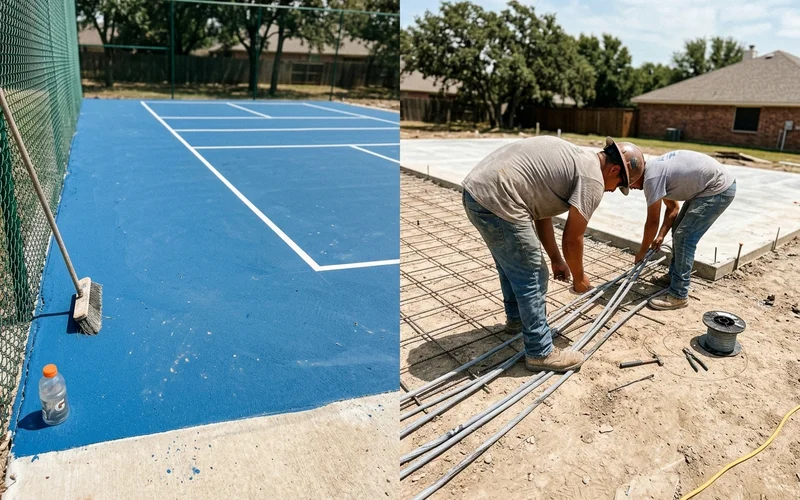
A full resurface handles everything that lives above the concrete.
Faded, chalky, or discoloured acrylic. Texture that has polished smooth in the high-traffic zones. Faded or incorrect line markings. Surface and shrinkage cracking, repaired with a reinforced membrane. Localised low spots, corrected with levelling compound to nickel-test tolerance. Algae staining and years of organic buildup, stripped back with power washing.
The process is preparation, crack repair, levelling, adhesion promoter, acrylic resurfacer coats with graded silica sand, colour coats, and fresh regulation striping.
The result is a court that looks and plays like new, with another six to ten years of service life. It is also the natural moment to change the colour scheme, add pickleball lines to a tennis court, or upgrade to cushioned acrylic.
What Resurfacing Cannot Fix
Slab failure. And in North Texas, slab failure is common, because a great many older courts were poured on conventional rebar-reinforced slabs that Blackland Prairie clay simply defeats over time.
The indicators are consistent and you can check most of them yourself.
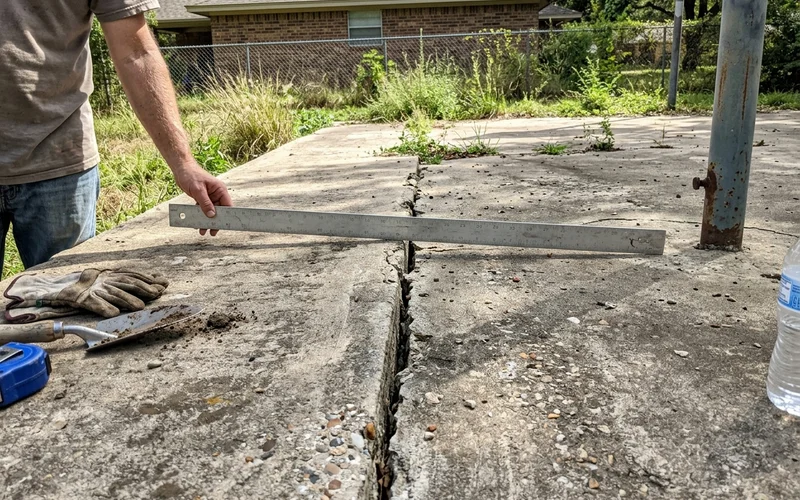
Cracks through the full slab depth, not just splits in the coating. Look at the crack edge: if you can see concrete rather than just coating layers, it is structural.
Height difference across a crack. Lay a straight edge or even a shoe across it. If one side sits higher than the other, the slab has moved.
Cracks that reopened after previous repairs. A crack that has been filled and came back is telling you the movement is ongoing.
Multiple parallel cracks across the pad, which suggests systematic movement rather than a single stress point.
Ponding that suggests tilt, particularly water collecting in a direction the court was not built to drain.
Any of those, and resurfacing is the wrong scope.
Cost Per Year, Not Cost
Resurfacing is substantially cheaper than a rebuild, and comparing the two headline numbers makes it look like an easy decision. The useful comparison is cost per year of service.
| Scenario | Outcome | Realistic service life |
|---|---|---|
| Resurface a sound slab | Court restored fully | 6–10 years |
| Resurface a moving slab | Cracks reappear | 1–3 years |
| Rebuild on engineered post-tension slab | New court | Slab decades, surface renewed on cycle |
A resurface that lasts two seasons before the cracks return is more expensive per year than a rebuild that lasts decades, and you have paid for the resurface as well. That is why we will recommend a rebuild when the evidence points that way, even though it is the harder conversation and the larger project for us to sell.
What a Rebuild Involves
Breaking out and removing the existing slab, then reassessing the sub-base beneath it, since a failed slab often means the base was inadequate too.
From there it is a new court: compacted crushed aggregate sub-base, vapour barrier for moisture mitigation, post-tension tendon grid, perimeter grade beam, monolithic pour screeded to a continuous 1% slope drainage plane, tendon stressing with recorded elongation, cure, then the full seven-layer acrylic system and regulation striping.
The saving compared with a greenfield court is that site access, layout, setbacks, and often fencing are already established. The demolition and removal cost partly offsets that.
Getting a Straight Answer
The assessment is free and it is diagnostic rather than promotional.
We trace the crack pattern to see whether it follows soil movement or surface stress. We check for height differences across every crack. We flood the court and map the low spots. We look at the perimeter drainage, the edges, and how the slab meets the surrounding ground.
Then we tell you which situation you are in, and why.
Plenty of courts we are called to assess turn out to need nothing more than a clean, crack repair, and a resurface, and we are happy to say so. The ones that need a rebuild get told that too, with the evidence.
You can read more about what each path involves on our court resurfacing and repair page, or get a free assessment and find out which one your court needs.