Maintenance Is the Cheapest Thing You Will Ever Do to a Court
A well-built acrylic court surface has a service life of roughly six to ten years before it needs resurfacing. Where a specific court lands in that range is determined almost entirely by three things: sun exposure, use volume, and maintenance.
You cannot change the first two. The third costs very little and reliably adds years, and it is what pushes back the point where you face resurfacing versus a full rebuild.
Here is what actually matters, in order of impact.
Keep Organic Material Off the Surface
This is the single most important maintenance task and the one most often neglected.
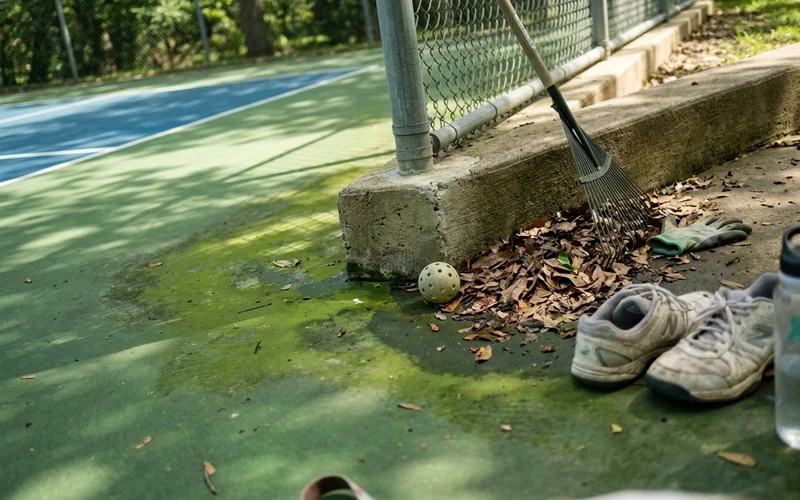
Leaves, seed pods, grass clippings, and general debris sitting on a court surface do two things. They hold moisture against the acrylic, and as they break down they feed algae. A leaf that sits through a wet fortnight leaves a mark you can still see a year later.
Sweep or blow the court regularly. Weekly during leaf fall is not excessive if you have trees nearby, and monthly is a reasonable baseline otherwise. Pay attention to corners and edges where debris collects and where a court is shaded, since those areas stay damp longest.
This takes ten minutes and it prevents most of the problems the rest of this guide describes.
Wash Once or Twice a Year
A proper clean once or twice a year strips the film of dust, pollen, and organic residue that builds up even on a swept court and gradually dulls both colour and texture.
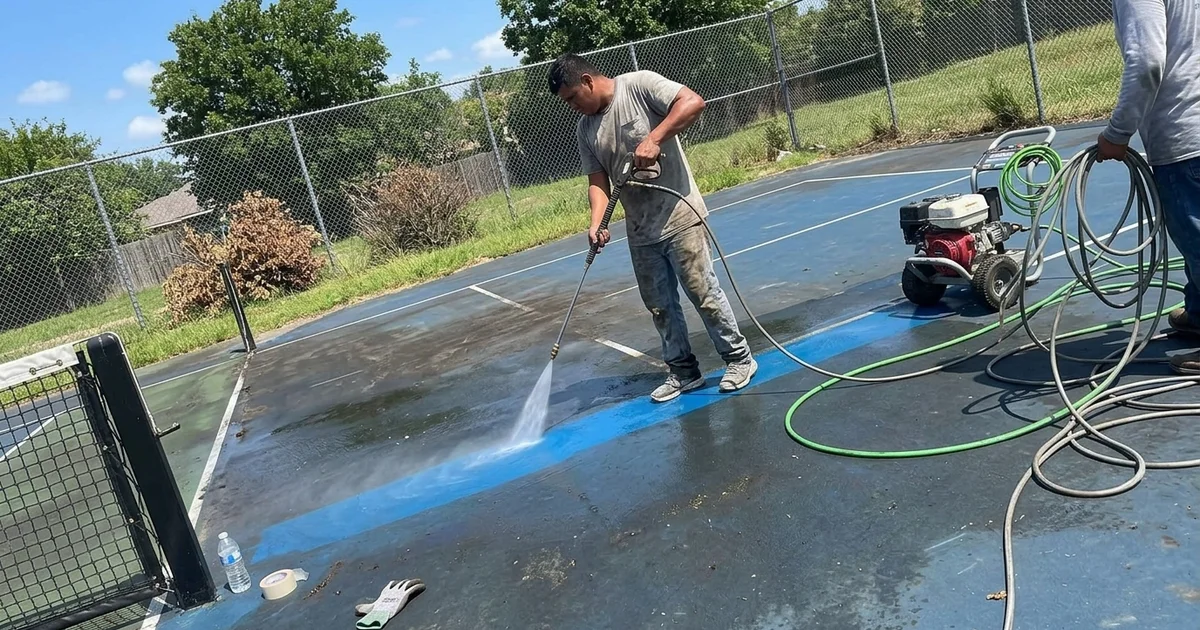
Pressure washing is the usual method, and technique matters more than equipment.
Use moderate pressure. The texture in an acrylic surface comes from graded silica sand held in the coating. Excessive pressure strips it out, which reduces traction, which is a safety issue rather than a cosmetic one.
Use a wide fan tip and keep moving. Concentrating the jet in one spot, or lingering, does damage quickly.
Stay back from the surface. Distance reduces effective pressure and gives you a more even result.
Be careful around lines. Line paint is thinner than the surrounding surface and is the first thing to suffer from aggressive washing.
If you are not confident, this is worth having done professionally. A bad pressure wash can take more life off a surface than a year of neglect.
Deal With Algae Properly
Algae is a traction problem, not just an appearance problem. A damp, algae-affected surface is genuinely slippery, and it forms in exactly the places players run: shaded corners and areas that stay wet.
The root cause is almost always moisture that is not leaving. Check that the drainage path is clear, that any perimeter channel or swale is not silted up or covered by landscaping, and that overhanging vegetation is not keeping an area permanently shaded and damp.
Treating the algae without fixing the moisture just resets the clock. Both need doing.
Keep the Drainage Path Clear
Your court was built to shed water in a specific direction to a specific place. Over a few years, landscaping grows, mulch migrates, and silt accumulates, and that path stops working.
Walk the perimeter after a heavy storm and watch where water actually goes. If it is ponding at an edge rather than leaving, something is blocking it. Clearing a silted channel is a twenty-minute job that prevents the surface degradation and soil moisture problems that standing water causes.
Seasonal Schedule for North Texas
| Season | Tasks |
|---|---|
| Spring | Full wash after pollen season, check drainage after storms, inspect for new cracks |
| Summer | Sweep regularly, rinse dust, check net tension and hardware |
| Fall | Frequent debris clearing during leaf fall, clear perimeter drainage |
| Winter | Keep debris off, inspect surface and lines, plan any resurfacing for spring |
Twice a year, walk the court properly and look at it: cracks appearing or widening, areas where texture feels smoother underfoot than elsewhere, lines fading, and hardware needing attention. Catching a crack early is the difference between a small repair and a resurface.
When Maintenance Is No Longer Enough
Maintenance preserves a surface; it does not restore one. The signs that a court has reached the end of its surface life are consistent.
Colour has faded noticeably and unevenly. The surface feels chalky underfoot. Texture has polished smooth in the high-traffic zones. Lines have faded to the point of being hard to read. Cracking has appeared or existing cracks have widened.
At that point resurfacing is the answer, and a court that has been well maintained often reaches that point closer to ten years than six. That is the whole return on the ten minutes a week.
You can read about what a full resurface involves on our court resurfacing and repair page, including crack repair and levelling as part of the same project.