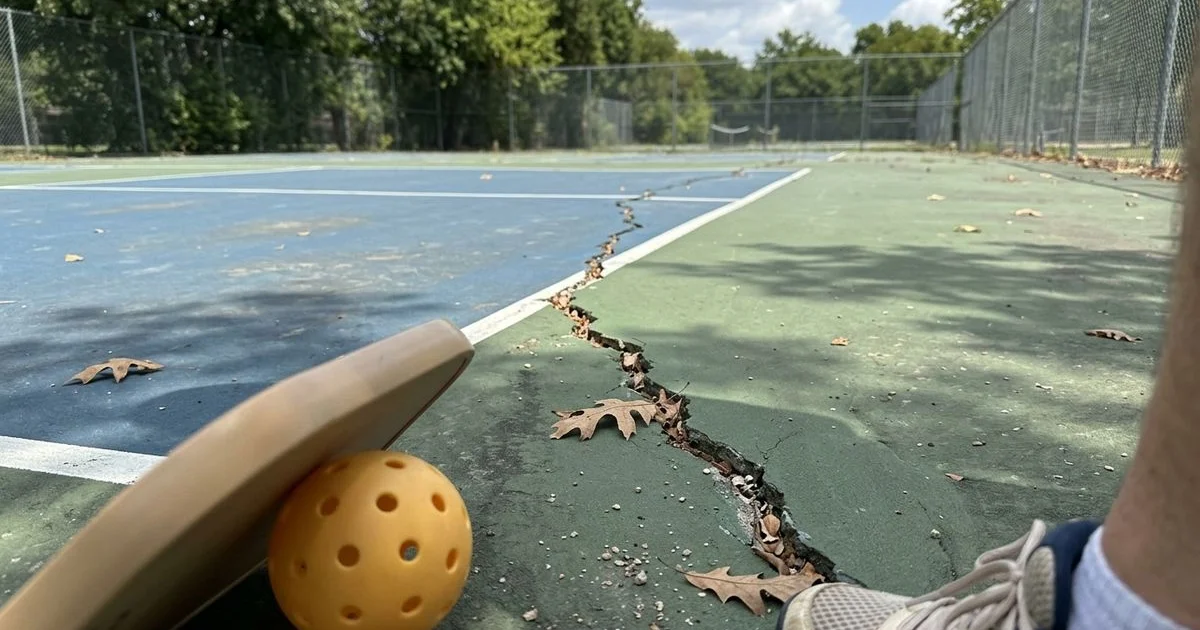
Start by Identifying What Kind of Crack You Have
Not all court cracks are the same problem, and the repair that works for one is a waste of money on another.
Surface or hairline cracking. Fine cracks in the acrylic coating itself, often in a web pattern. Caused by UV exposure, coating age, and thermal cycling. The slab underneath is fine. Easy to address.
Shrinkage cracking. Thin, often straight cracks that appeared in the first year or two after the court was poured, from concrete curing rather than soil movement. Usually stable and repairable.
Structural cracking. The serious one. A crack running through the full depth of the slab, frequently with the two sides at different heights, and frequently reopening after previous repairs. Caused by soil movement beneath the slab.
The distinction matters enormously, because structural cracking is not a surface problem and cannot be solved with a surface fix. It is the same evidence that settles resurfacing versus a full rebuild.
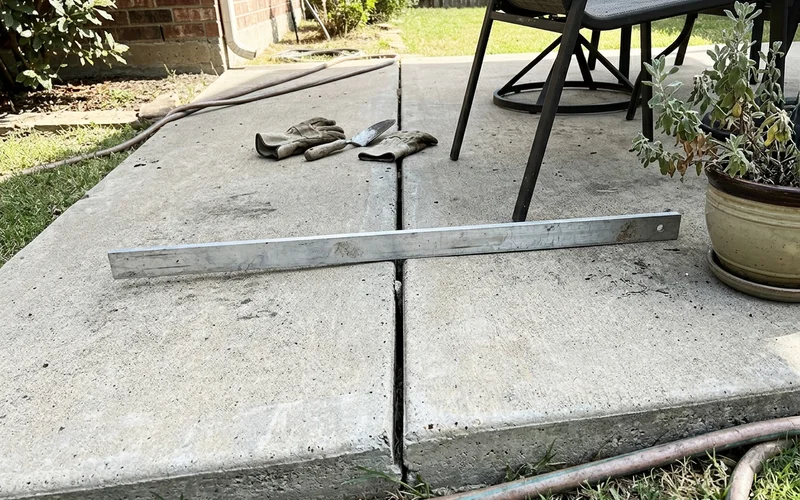
Why Courts Crack in North Texas Specifically
Blackland Prairie clay has a high plasticity index. It absorbs water and swells, then dries and contracts, and in a Texas year that cycle runs hard between wet springs and drought summers.
It also does not move uniformly. Soil under a tree dries faster than soil in the open. Soil beside irrigation stays wetter than soil at the far corner. Under a single slab, one edge can be rising while the opposite edge falls.
Concrete is strong in compression and weak in tension. Differential movement puts a slab into tension across the span, and conventional rebar reinforcement does not prevent that. It controls how a crack behaves once it exists; it does not stop it forming.
This is why nearly every cracked court we are asked to assess in DFW was poured on a conventional slab, and why we build every new court on an engineered post-tension slab instead.
How Proper Crack Repair Works
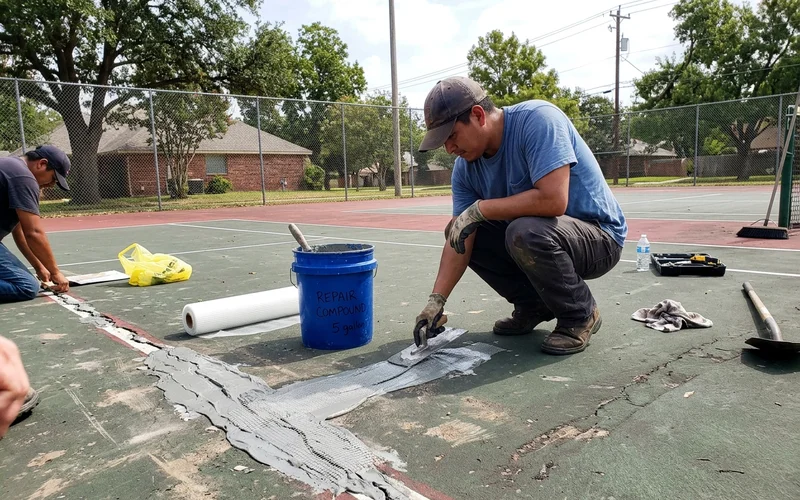
For surface, shrinkage, and stable cracks, a reinforced membrane system is the correct repair.
The crack is routed out and cleaned so the repair material bonds to sound concrete rather than to debris. A fibreglass or carbon-fibre reinforced membrane is then applied across the crack, bridging it and distributing any future minor movement across a wider area rather than concentrating it at a single line.
The membrane is levelled flush and the acrylic resurfacing system goes on over the top.
What does not work is caulk or rigid patching compound. Rigid filler in a crack that still moves either pushes out or cracks itself, and either way it telegraphs straight back through the new surface within months. It is the most common failed repair we see.
When Repair Is the Wrong Answer
This is the conversation we would rather have early than late.
If the slab is actively moving, a membrane repair buys time rather than solving the problem. The crack reopens, usually within a season or two, and you have paid for a resurface that now has a crack through it.
The indicators are consistent:
- Cracks running through the full slab depth, not just the coating
- A height difference between the two sides of a crack
- Cracks that have reopened after previous repairs
- Water ponding in patterns that suggest the slab has tilted
- Multiple parallel cracks across the pad
Any combination of those means the honest recommendation is a rebuild on a properly engineered post-tension slab, even though it is the harder conversation and the larger project.
| Crack type | Repair approach | Expected outcome |
|---|---|---|
| Hairline surface | Clean, resurface | Fully resolved |
| Shrinkage, stable | Reinforced membrane, resurface | Long-term hold |
| Structural, stable | Membrane, monitored | May reopen eventually |
| Structural, active | Slab rebuild | Only durable solution |
Getting an Honest Assessment
Diagnosis is free and it is the whole basis of the recommendation.
We trace the crack pattern to see whether it follows soil movement or surface stress, check for height differences across each crack, flood the court to map low spots, and look at the drainage path and edges.
That gives a straight answer on whether a repair and resurface will hold or whether the slab is the problem. We give the same answer either way, including when it costs us the easier sale. You can read more about how we approach court resurfacing and repair, or get a free assessment and find out exactly what you are dealing with.
Preventing Recurrence
If you do end up rebuilding, the specification is what determines whether you go through this again.
An engineered post-tension slab holds the whole pour in compression so it rides soil movement as one unit. A vapour barrier limits moisture migration from below. A perimeter grade beam stiffens the edges where moisture swing is largest. And a continuous 1% drainage plane stops water standing on the surface and keeping one area of soil saturated while the rest dries.
Those four things, together, are what a court needs to survive Blackland Prairie clay. Any one of them missing is where the next crack starts.