The Slab Is the Same. Almost Everything Else Is Not.
This is the clearest way to frame the difference.
Blackland Prairie clay does not care whether a court belongs to a family or a school district. Both need an engineered post-tension slab with moisture mitigation and a continuous drainage plane, because the soil movement is identical.
What changes is everything built on top of that slab, and everything that surrounds the project.
Scale and Site Complexity
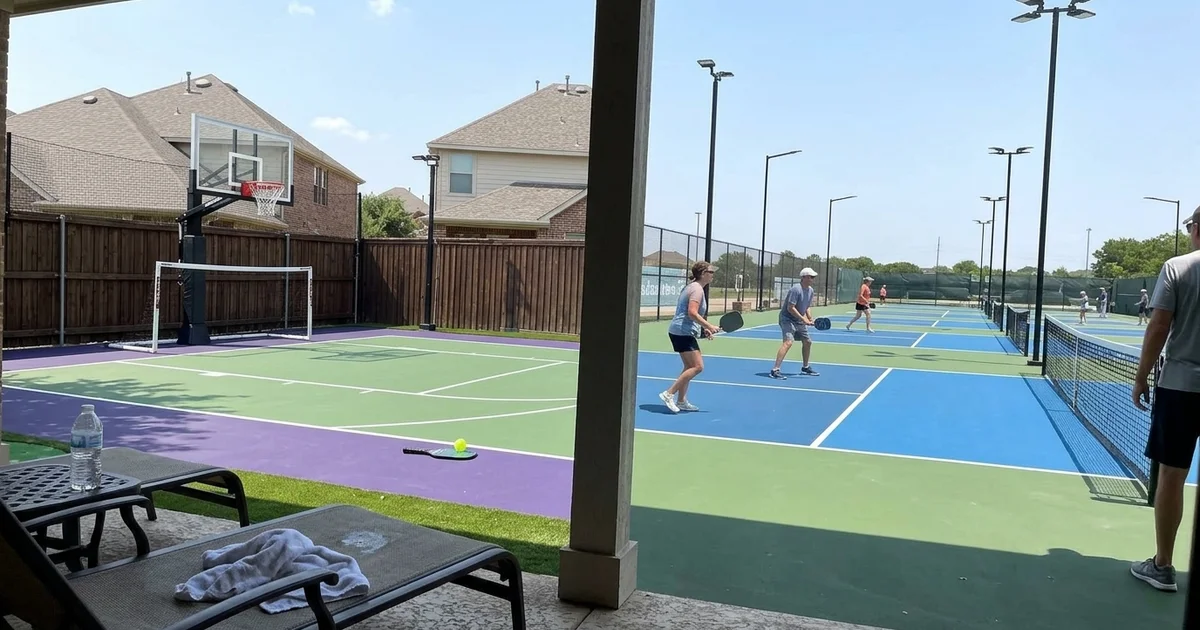
A residential court is one pad in a backyard. A commercial court is frequently a facility.
Multi-court banks and shared walkways bring court spacing, circulation routes, gate positions, spectator areas, and site-wide drainage into scope. A single amenity court still has accessible approach routes and connection to an existing path network to solve.
Concrete volume alone changes the operation. A four-court bank is a substantially larger pour requiring more trucks in sequence and a clear weather window, which is why commercial pours get scheduled more carefully than residential ones.
Durability Specifications
The difference in use volume is larger than people expect. A community court can see more play in a month than a backyard court sees in a year.
That shows up in specific components.
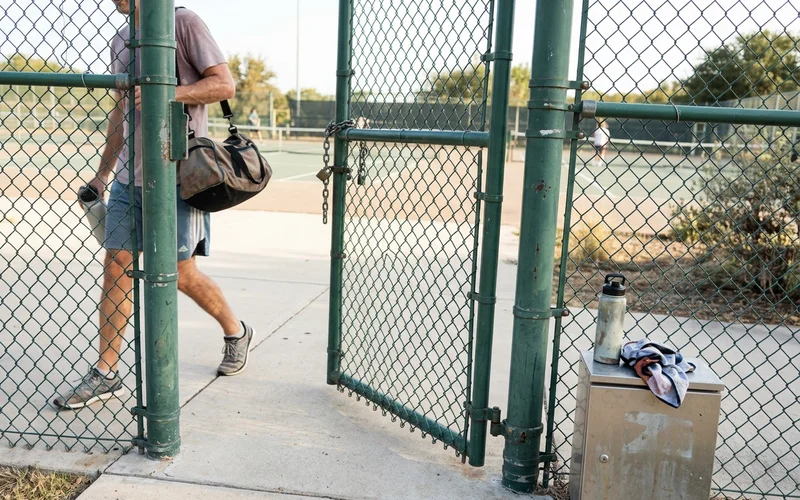
Fencing and gates. Heavier gauge, stronger posts, and hardware rated for constant cycling. A residential gate is opened a few times a week; a park gate is opened hundreds of times.
Equipment. Goals, net posts, and hardware specified for public use, often with tamper-resistant fixings.
Surface texture. Traction has to suit mixed abilities and mixed footwear, since public users arrive in whatever shoes they were wearing.
Everything that gets touched. Latches, bench fixings, and signage all wear at a pace residential equivalents never reach.
Permitting Complexity
Residential permitting is usually one city permit plus an HOA architectural review, and it takes three to six weeks.
Commercial permitting frequently involves multiple agencies, stricter application of noise and lighting ordinances because facilities sit closer to more residents, additional internal approvals from boards or districts, and sometimes drainage or civil review. Four to ten weeks is a realistic range, longer if a variance is needed.
We manage both, and both are included rather than billed separately. But a commercial client should plan the calendar around permitting rather than construction, because permitting is nearly always the critical path.
Maintenance and Renewal
This is where commercial ownership differs most over time, and where budgeting most often falls short.
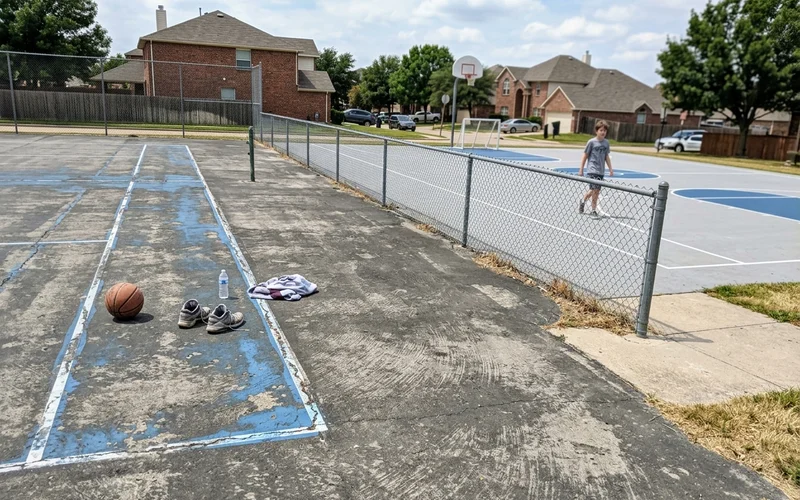
A well-maintained residential acrylic surface typically goes six to ten years before resurfacing. A heavily used community or school court will need it sooner, sometimes considerably sooner, because surface texture polishes under constant traffic and line paint fades faster.
That is not a defect, it is a consequence of the court doing its job. What matters is that the organisation owning it plans for the cycle in its reserve study rather than treating resurfacing as an unexpected capital event in year six.
We set realistic expectations at handover and provide written maintenance guidance aimed at whoever will actually look after the facility.
Budgeting
| Factor | Residential | Commercial |
|---|---|---|
| Typical scope | One court | One court to multi-court facility |
| Slab specification | Engineered post-tension | Same |
| Fencing and hardware | Standard duty | Heavy duty |
| Permitting | 3–6 weeks, one or two layers | 4–10 weeks, multiple agencies |
| Accessibility | Not usually applicable | Designed in from the start |
| Phasing | Rare | Common |
| Resurfacing cycle | 6–10 years | Shorter, use-dependent |
| Cost per court | Higher for a single build | Often lower at scale |
Cost per court is worth dwelling on. Mobilisation, site setup, design, and permitting effort are spread across however many courts you build, so a four-court bank does not cost four times a single court. Against that, commercial scope adds walkways, accessible routes, lighting, seating, and often phasing.
Choosing a Builder
The question to ask is not whether a contractor can pour concrete. It is whether they have done this specific kind of project before.
Commercial work requires documentation a board or procurement process can use, experience managing multi-agency permitting, the ability to phase construction around active users, and an understanding of accessibility requirements. None of those are construction skills, and all of them determine whether a project runs smoothly.
Ask for comparable completed commercial projects. We have built for HOAs, schools, municipal parks, private clubs, and developers across Texas as part of 325-plus courts completed, and we are happy to point to specific examples.
You can see the full scope of our commercial court construction service, including how we handle board documentation and phased delivery.