What Blackland Prairie Clay Does to Concrete
Dallas–Fort Worth sits on Blackland Prairie clay, one of the most expansive soils in the United States. Expansive means what it sounds like: the clay absorbs water and swells, then dries out and contracts. Over a Texas year, with wet springs and drought summers, that cycle runs hard.
The technical measure is the plasticity index, and North Texas clay scores high on it. In practical terms, the ground under your yard moves several inches vertically across a season, and it does not move evenly. One corner of a slab can be rising while another is falling, which is why the slab has to be engineered before you even settle what size lot a backyard court needs.
Concrete is enormously strong in compression and weak in tension. When the soil beneath a slab lifts in one place and drops in another, the slab is put into tension across the span between them. Standard reinforcement, meaning steel rebar laid in a grid, does not prevent that tension. It controls how a crack behaves once it forms, but it does not stop the crack forming.
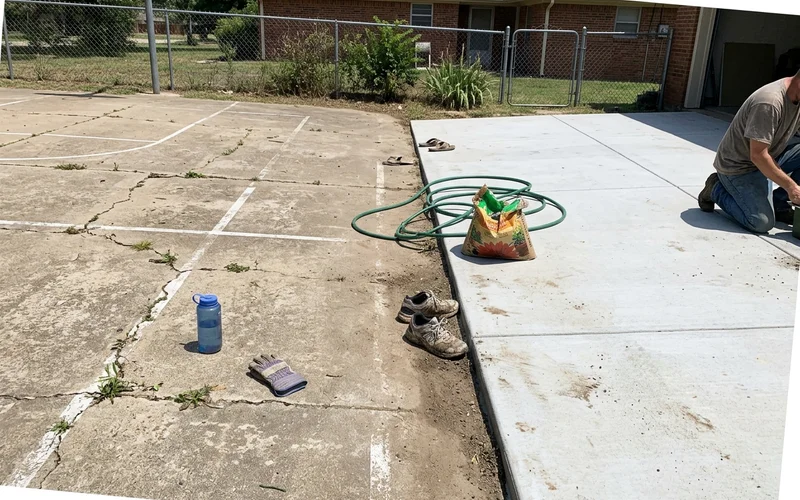
That is the single most common failure we are called out to inspect. A court poured five or eight years ago with a conventional slab, now split along one or two lines, with the acrylic surface torn open above the crack. The concrete mix was usually fine. The soil moved and there was nothing holding the slab together against it. This is exactly why we build every court on this specification, including our pickleball court construction.
How a Post-Tension Slab Works
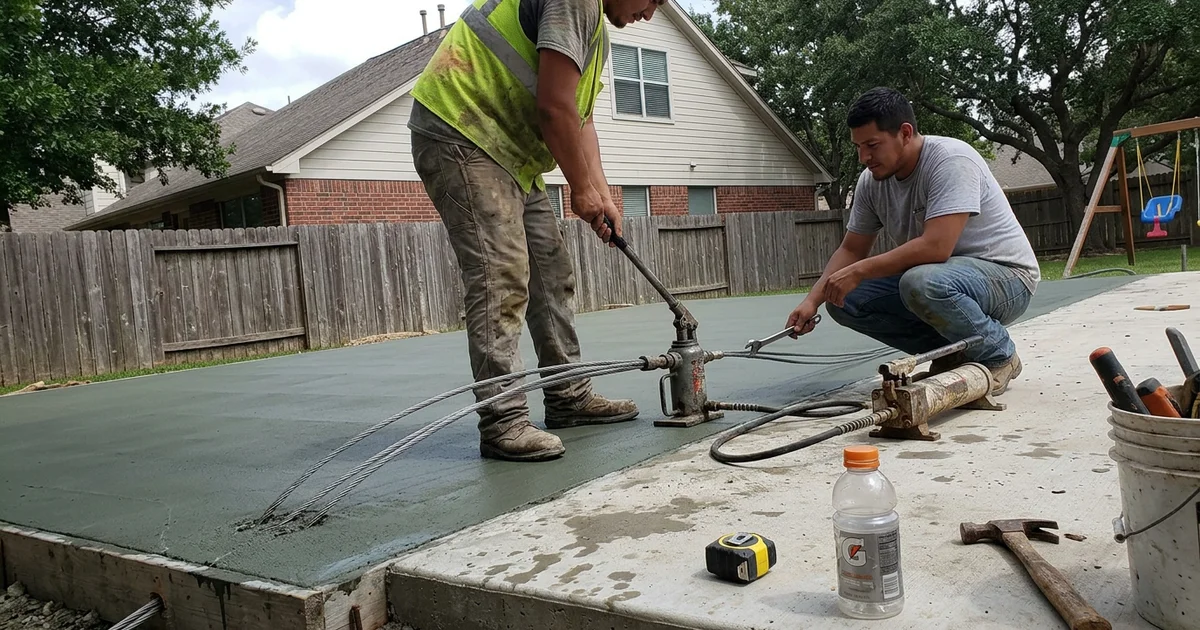
A post-tensioned slab is a different structural idea. Steel tendons, sheathed in plastic and greased so they can move inside the concrete, are laid in a grid before the pour. The concrete goes down around them and is left to cure.
Once the concrete reaches a specified strength, usually a few days later, each tendon is pulled with a hydraulic jack to a calculated force and locked off at an anchorage. That is the tensioning step. The tendons are now permanently stretched, and because they are anchored at both ends, they squeeze the entire slab into compression.
The elongation is measured and recorded during stressing. It is how we confirm each tendon actually reached its design force rather than assuming it did, and it is a standard part of the process on a properly engineered slab.
Why it matters: concrete that is held in compression can absorb a great deal of tension from soil movement before any part of it goes into net tension. The slab behaves as a single engineered unit rather than as a collection of panels waiting for a weak point. The soil still moves. The slab rides it.
The Layers That Sit Beneath and Around It
Post-tensioning on its own is not the whole answer. Three other elements do the rest of the work.
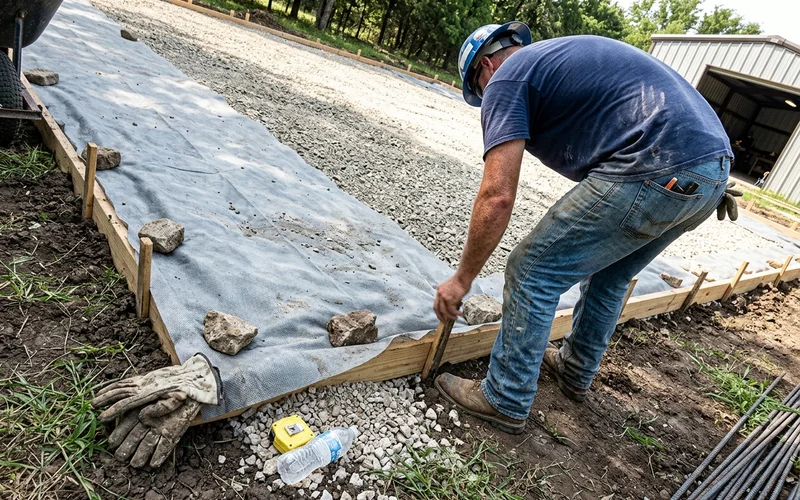
Compacted aggregate sub-base. We excavate to depth and lay compacted crushed aggregate. This gives uniform support beneath the slab and a predictable bearing layer, rather than leaving concrete sitting directly on native clay that behaves differently from one metre to the next.
Vapour barrier and moisture mitigation. A barrier beneath the slab limits moisture migration from the soil into the concrete. In expansive clay, controlling moisture is half the battle, because moisture change is what drives the soil movement in the first place.
Perimeter grade beam. A thickened reinforced edge around the slab perimeter. The edges of a slab face the biggest moisture swing, because that is where rainfall lands and where irrigation runs. A grade beam stiffens that boundary.
Drainage Is Part of the Structure
The last piece is slope. Every court we pour is set to a continuous 1% slope drainage plane, established before the forms go in rather than corrected afterwards.
This is not just about playability after rain, though a court that sheds water in minutes instead of holding it for two days is worth having. Standing water on a surface degrades the acrylic, grows algae that makes the surface slick, and, most importantly, keeps the soil at that end of the slab saturated while the other end dries. That is a moisture differential, and a moisture differential is exactly the condition that moves a slab.
Drainage and structure are the same problem viewed from two angles. A court that drains properly puts less differential movement into its own foundation.
| Element | Standard slab | Engineered post-tension slab |
|---|---|---|
| Reinforcement | Rebar grid | Stressed tendons, slab in compression |
| Behaviour in clay | Cracks at weak points | Moves as one unit |
| Moisture control | Often none | Vapour barrier beneath slab |
| Edge stiffness | Same thickness throughout | Perimeter grade beam |
| Drainage | Frequently flat | Continuous 1% slope plane |
| Typical lifespan here | 2–3 seasons to first crack | Decades |
What This Means When You Are Comparing Quotes
When you collect quotes for a court in DFW, the slab specification is where the real difference between them usually sits, and it is rarely the line item people compare.
Ask directly whether the slab is post-tensioned. Ask whether there is a vapour barrier. Ask what slope is being set and in which direction water will leave. A builder who can answer those three questions clearly is telling you something about how the court will behave in year seven.
A cheaper quote with a conventional slab is not a bargain in this soil. It is a deferred cost, and the deferred cost is a rebuild rather than a repair, because once a slab has split structurally no amount of resurfacing puts it back.
If you are weighing options for a court in North Texas, the foundation is the decision that everything else rests on, literally. Everything above it, the acrylic system, the striping, the nets, can be renewed. The slab cannot.
We are happy to walk through the specification for your specific site and soil conditions during a free on-site consultation, and you can request a free quote whenever you are ready.