Start With the Pad, Not the Playing Area
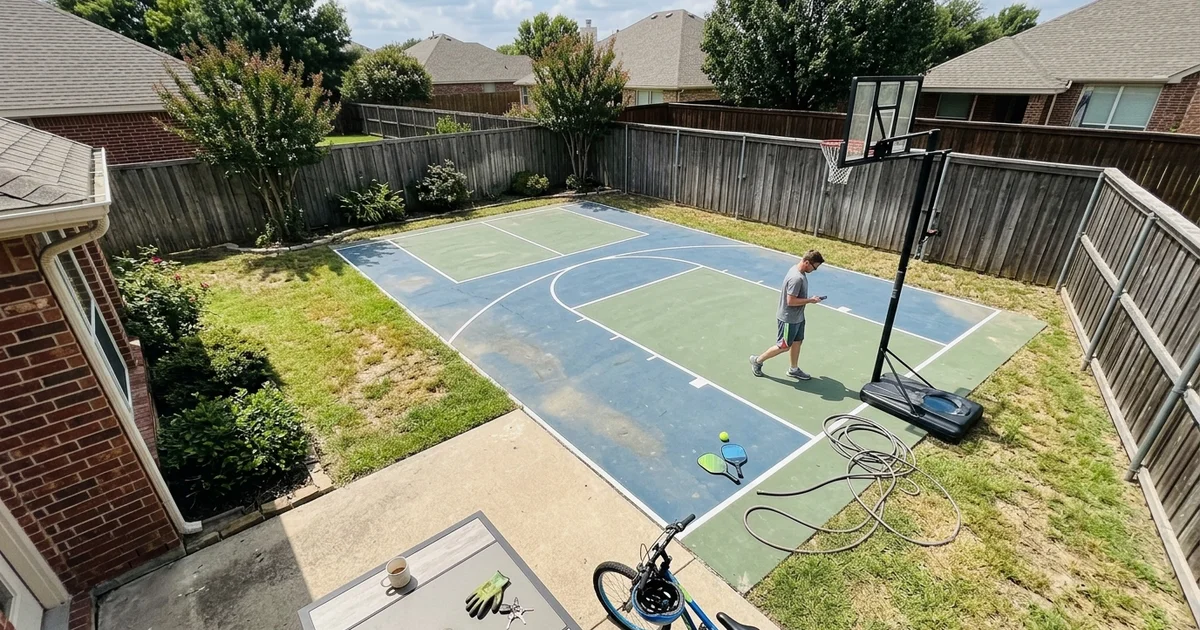
The most common mistake in sizing a backyard court is looking up the playing dimensions and stopping there. A pickleball court is 20 by 44 feet, but nobody plays on a 20 by 44 foot slab. Players chase balls past the baseline, and a court poured right to the line is cramped and genuinely unsafe.
What you actually need is the pad: the playing area plus the buffer around it, sitting on the kind of engineered base described in why post-tension slabs are required in North Texas. Here is the realistic footprint for each sport.
Pickleball. A 20 by 44 foot playing boundary on a 30 by 60 foot pad. That gives roughly eight feet behind each baseline and five feet either side, which is the recreational standard and the size we recommend for pickleball courts.
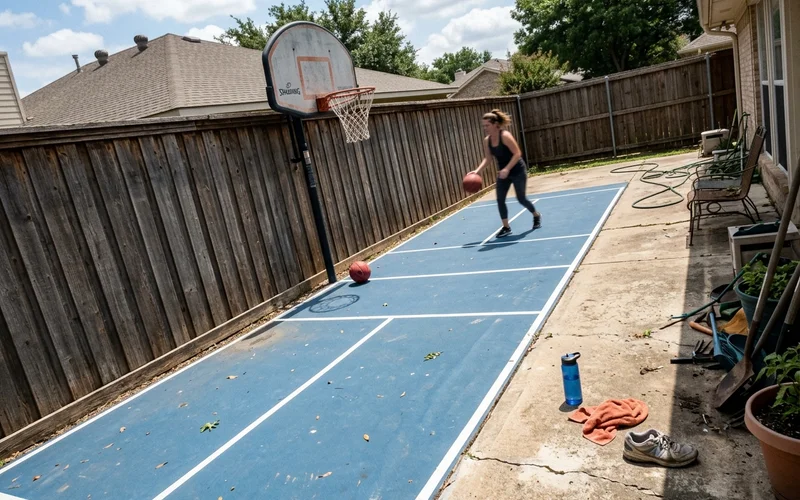
Basketball. More flexible than any other sport, because there is no fixed boundary you must respect. A mini court can work in as little as 20 by 30 feet. A comfortable half court is around 30 by 50. A full high school layout is 50 by 84, and an NBA-size court is 50 by 94.
Tennis. The largest footprint by a wide margin. A 36 by 78 foot playing boundary on a 60 by 120 foot pad, giving 21 feet of run-off behind each baseline and 12 feet either side. This is the one sport where undersized surrounds are immediately obvious to anyone playing.
Multi-sport. Often the same 30 by 60 pad as pickleball, striped for basketball as well. This is why multi-sport is such good value: the footprint you need for one sport frequently carries two.
Setbacks Usually Matter More Than Total Yard Size
Plenty of yards that look big enough turn out not to be, and plenty that look marginal turn out to work. The difference is almost always setbacks.
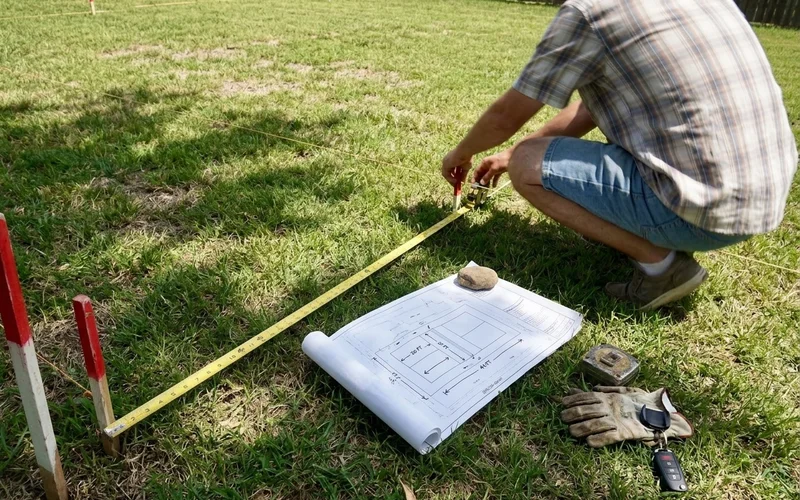
Two sets of rules apply. City setbacks determine how close any permanent structure can sit to a property line, and they vary across DFW municipalities. HOA covenants often add their own requirements on top, sometimes stricter, particularly around rear and side boundaries.
Then there is everything already in the yard: pool decks, mature tree canopy and root zones, septic systems, irrigation runs, drainage swales, and utility easements. Any one of these can shift the workable area more than the fence line does.
This is why a measurement on paper rarely answers the question. Standing in the yard with a tape does.
The question worth asking first
Not “how big is my yard” but “where can a permanent structure legally and practically sit in it”. Those are frequently very different rectangles.
Options When the Lot Is Tight
A marginal lot is not automatically a no. There are four moves we make regularly.
Rotate the court. Orientation is often set by habit rather than geometry. Turning a court fifteen or twenty degrees can open up clearance that a square-to-the-fence layout wastes. We have fitted regulation pads into yards two other builders declined.
Trim the buffer on one side. If one edge backs onto a fence rather than open yard, reducing the surround there and keeping it generous elsewhere is a reasonable trade. It changes how the court feels, and we will tell you where that line is.
Drop to a smaller layout. A half court instead of a full court, or a mini tennis court instead of a full-size one. A well-proportioned smaller court gets used more than a cramped large one, every time.
Go multi-sport. If the driver is family use rather than one specific game, a single 30 by 60 pad striped for basketball and pickleball delivers more play per square foot than a dedicated court of either kind.
Quick Reference by Sport
| Sport | Playing area | Recommended pad | Notes |
|---|---|---|---|
| Pickleball | 20 × 44 ft | 30 × 60 ft | Can flex to ~28 × 54 on tight lots |
| Basketball (mini) | Varies | From ~20 × 30 ft | Most flexible option |
| Basketball (half) | ~42 × 50 ft | ~30 × 50 ft typical build | Key, free-throw line, 3-point arc |
| Basketball (full) | 50 × 84 to 50 × 94 ft | Same | Needs a genuinely large lot |
| Tennis (full) | 36 × 78 ft | 60 × 120 ft | 21 ft run-off behind baselines |
| Tennis (mini) | Reduced proportionally | Considerably smaller | Good for drills and juniors |
| Multi-sport | Shared | Often 30 × 60 ft | Basketball plus pickleball overlay |
The Free Measurement Is the Real Answer
Everything above is a planning guide. What it cannot tell you is whether your specific yard, with its specific setbacks, trees, slope, and drainage, will take the court you have in mind.
A free on-site consultation takes about an hour. We measure properly, check the setbacks that apply to your address, look at fall direction and soil, and tell you what genuinely fits. Then you see it modelled in 3D on your actual lot before anything is committed.
If the answer is that a court does not work, you will hear that too. We would rather lose a project at the measuring stage than build something that never sat right in the space. You can get a free on-site measurement whenever you are ready to find out.