Two Ways a Court Gets Built
Almost every sport court in North Texas is built one of two ways, and the difference shapes your schedule, your budget, and who you call when something goes wrong three years later.
The multi-contractor model. A general contractor, or sometimes you directly, coordinates separate specialist trades. An excavation company cuts the site. A concrete contractor pours the slab. A surfacing company applies the acrylic and the lines. A fourth party installs fencing and equipment. Four companies, four schedules, four invoices, four warranties.
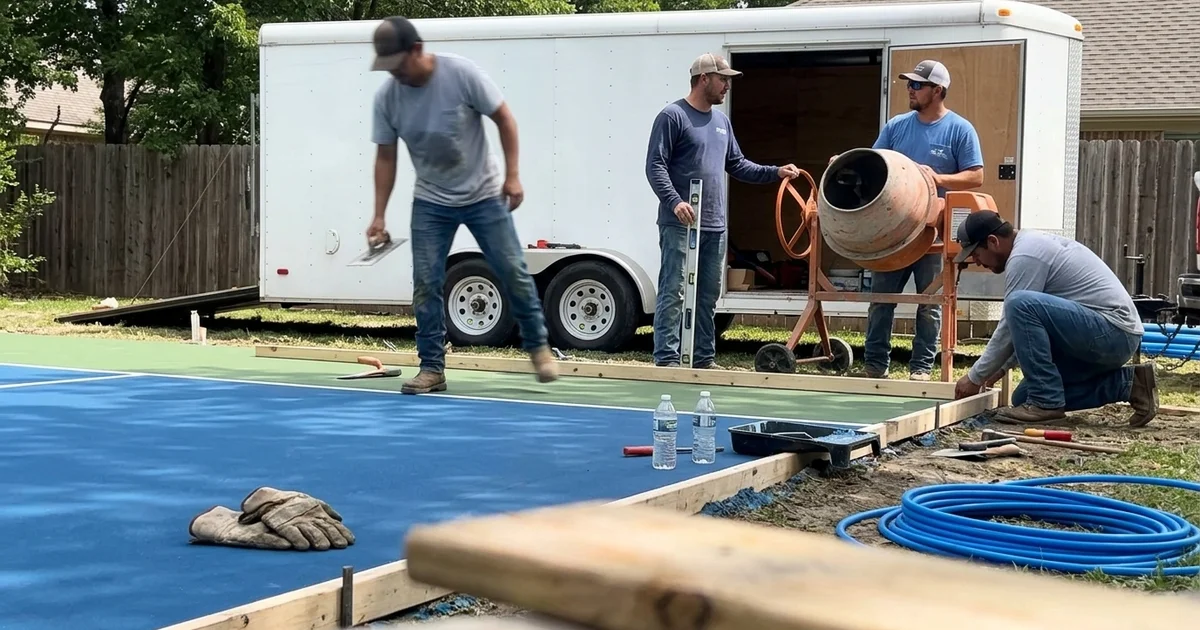
The turnkey in-house model. One crew, employed by one company, performs every stage from excavation to final walkthrough. One schedule, one invoice, one warranty, one phone number.
Both models produce courts. The differences show up in the places people do not think to ask about at quoting stage, starting with how long a sport court takes to build in Dallas.
Where Multi-Contractor Builds Lose Time
The handoff is the problem, and it is structural rather than anybody’s fault.
Your concrete contractor finishes the pour on a Tuesday. Your surfacing company is on another job for the next two weeks. The slab sits. When the surfacing crew arrives, they find a finish they are not happy with, and now there is a conversation between two companies who have no contractual relationship with each other, mediated by you.
Multiply that across four trades. Every handoff is a point where the schedule can stall, and each company is balancing your job against its own pipeline. An eight to fourteen week build is entirely normal in this model, not because anyone is slow, but because four independent calendars rarely line up neatly.
Where Multi-Contractor Builds Lose Accountability
The harder problem arrives later.
Say the acrylic surface develops a crack in year three. The surfacing company says the slab moved, which is a concrete problem. The concrete contractor says the slab is fine and the surface delaminated, which is a coatings problem. Both may genuinely believe they are right.
You are now the person holding two warranties that each point at the other. The practical outcome is often that nobody fixes it and you pay for the repair yourself.
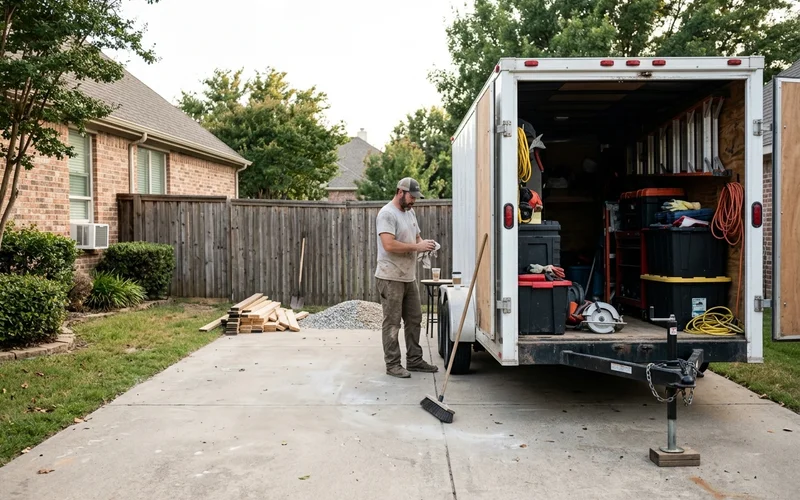
A turnkey builder cannot make that argument. We poured the slab and we laid the surface. If the two do not work together, that is ours to resolve. The single warranty is not a marketing line; it is a structural consequence of doing all the work.
Where the Cost Difference Actually Sits
People assume turnkey costs more because it sounds premium. In practice it usually costs less in total, for two reasons.
Markup stacking. A general contractor adds margin on top of each subcontractor’s price. Three or four trades means three or four layers of markup, none of which buys you anything physical.
Coordination cost. Delays cost money even when nobody bills for them, in equipment remobilisation, in repeated site setups, and in the change orders that appear when one trade finds a condition the previous one left behind.
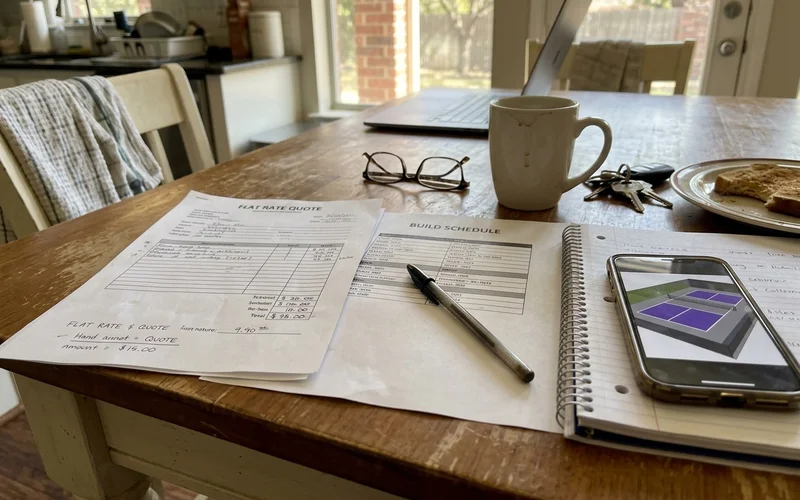
The pricing model matters as much as the number. An estimate that grows through change orders is how court budgets get wrecked. We quote flat-rate and all-inclusive after the on-site measurement, and that is the figure you pay.
Side by Side
| Factor | Multi-contractor | Turnkey in-house |
|---|---|---|
| Point of contact | Three or four | One crew lead |
| Typical timeline | 8–14 weeks | 25–30 days |
| Warranty | One per trade | Single, whole project |
| Pricing | Estimate plus change orders | Flat-rate, all-inclusive |
| Jobsite condition | Varies by trade | One standard, swept daily |
| Accountability for defects | Contested between trades | Single owner |
| Permitting and HOA | Usually yours | Handled free |
Why This Matters More on Commercial Projects
On a backyard court, a multi-contractor build is an inconvenience. On a community or facility project it can be a genuine problem.
Commercial work adds phasing requirements, resident or student access constraints, procurement documentation, and more permitting agencies. Coordinating four independent trades against all of that, while a board or facilities manager waits for answers, is where commercial court projects most often go sideways. Our commercial court construction work runs on the same single-crew model precisely because the stakes for schedule slippage are higher.
The Questions Worth Asking Any Builder
Whichever model you end up choosing, these four questions tell you what you are actually buying.
Who pours the concrete, by company name? If the answer is a different business, it is a subcontracted build.
Who applies the acrylic? This is the most commonly farmed-out stage in the industry.
Who do I call in year three if there is a problem? Listen for whether the answer is one party or several.
Is the quote flat-rate, and what triggers a change order? A builder who cannot answer this clearly is telling you the price may move.
There is nothing dishonest about the multi-contractor model, and some good courts are built that way. But you should know which one you are buying before you sign, because the differences do not show up in the photographs.
If you want a single number covering everything from excavation to the final walkthrough, you can get a flat-rate quote after a free on-site consultation.