The Core Combinations
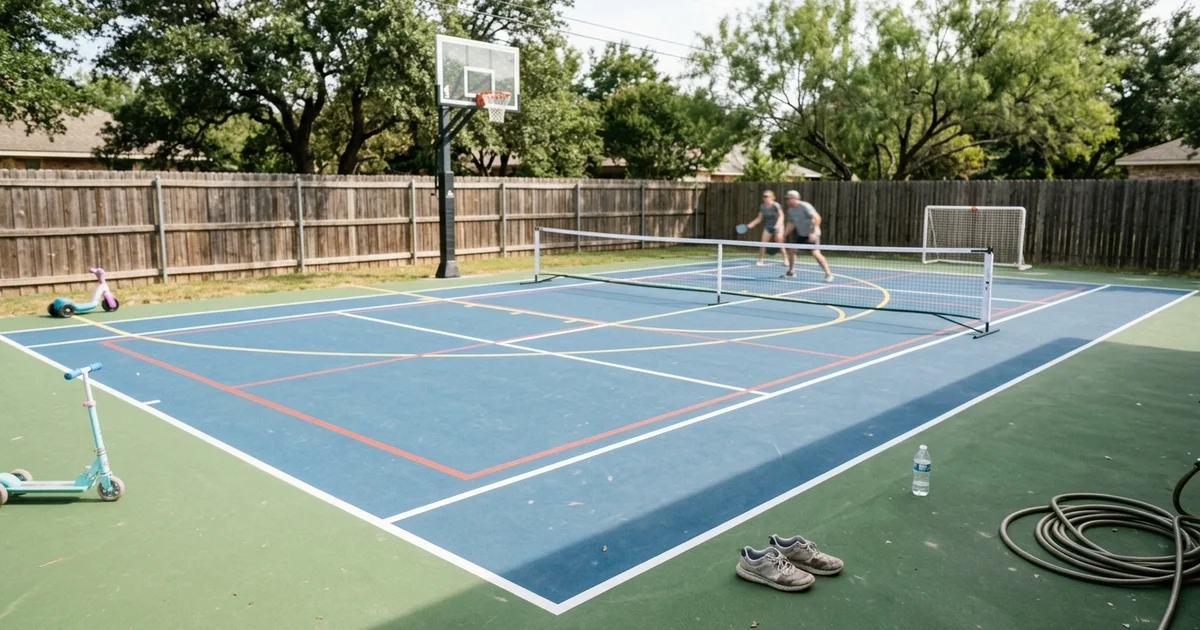
A multi-sport court is one engineered slab carrying several sets of playing lines, with net systems that swap in seconds. Here is what actually combines well.
Pickleball and basketball. The most popular pairing by a wide margin, and the one we recommend most. A 30 by 60 foot pad holds a half-court basketball layout and a full regulation 20 by 44 pickleball court. Basketball gets the after-school use, pickleball brings the adults out in the evening, and the changeover is seconds.
Pickleball and volleyball. Volleyball needs only floor anchors and a net, both of which sit flush in the surface. Adding it to a pickleball pad costs very little and turns the court into a party space.
Basketball, pickleball and volleyball. Three sets of lines on a standard pad is achievable with careful colour design, which is where multi-sport line striping does the work. This is our common three-sport configuration.
Tennis with pickleball overlay. Works well, but only in one direction: build a full 60 by 120 tennis court and stripe pickleball on it. Trying to fit tennis onto a smaller multi-sport pad does not work, because the tennis footprint dwarfs everything else and strands the other sports in the middle of an enormous slab.
Four-square, shuffleboard and similar. Near-free additions during line work, and genuinely useful if there are younger children in the house.
Why Line Colour Design Decides Everything
A multi-sport court succeeds or fails on whether players can read the right boundaries instantly.
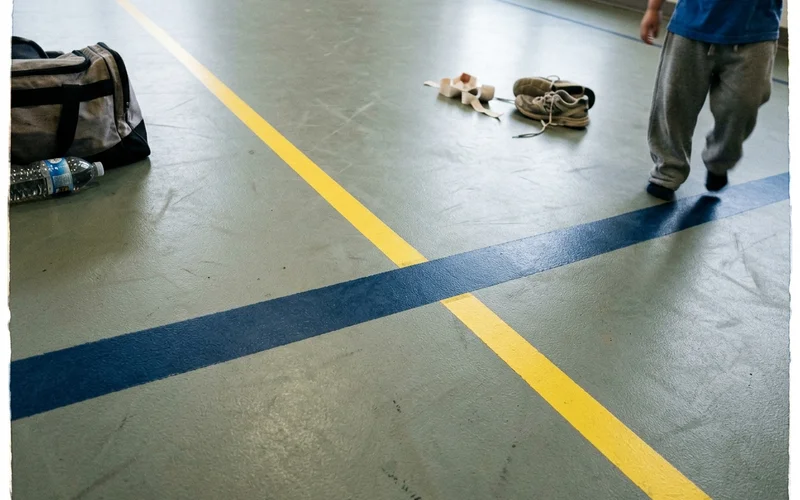
The failure mode is two line sets in similar tones. The eye has to work during a rally, players second-guess calls, and the court feels cluttered rather than versatile. It is entirely avoidable and it comes down to choices made at design stage.
We use genuinely distinct colours, typically a neutral primary set for the dominant sport and a bright contrasting set for the secondary. We manage boundary tolerances so neither sport’s dimensions are compromised by the other, and we use contrasting keys and borders so each playing area reads as its own space.
You see the whole layout rendered in 3D, in the actual colours, on your actual slab dimensions, before anything is painted.
Net Systems and Anchors
The hardware is what makes switching sports practical rather than theoretical.
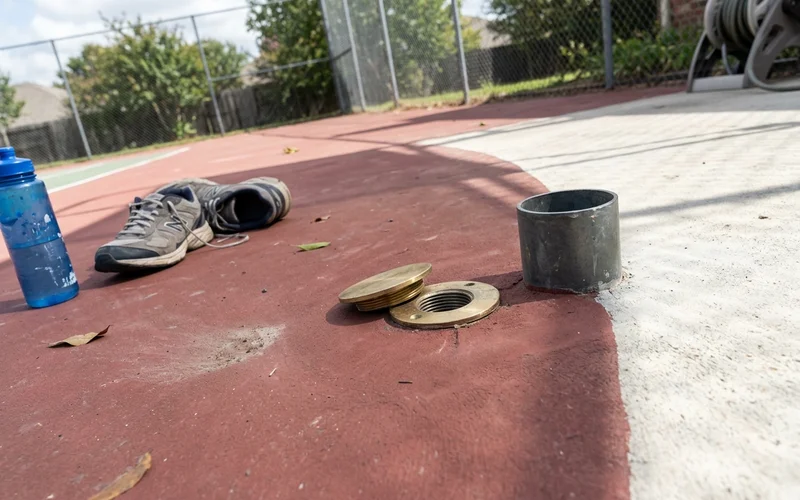
Dual-purpose net sleeves are cast into the slab during the pour, set flush with the finished surface, with caps that sit level when nothing is in them. A height-adjustable multi-sport net system drops straight in and sets to the right height for whichever sport you are playing.
Volleyball floor anchors work the same way, cast flush rather than drilled into cured concrete afterwards.
This matters more than it sounds. Retrofitted anchors core-drilled into a finished slab are a weak point, they can crack the surrounding surface, and their caps often sit proud enough to catch a toe. Cast sleeves avoid all of that, and unused ones cost almost nothing, which is why we suggest casting for any sport you might conceivably add later.
What Fits on What Pad
| Pad size | Realistic sport mix |
|---|---|
| 30 × 60 ft | Half-court basketball + pickleball, optional volleyball |
| 30 × 60 ft + extras | The above plus four-square or shuffleboard |
| Larger custom pad | Three sports with zones for simultaneous play |
| 60 × 120 ft (tennis) | Tennis with pickleball overlay |
Note that the standard multi-sport pad is the same 30 by 60 footprint as a dedicated pickleball court. That is precisely why multi-sport delivers such good value: the space you needed for one sport carries two or three.
Choosing Your Mix
The useful question is not how many sports can fit, but which will actually get played.
Households with primary and middle school children get the most from basketball plus pickleball. Households that entertain benefit from adding volleyball, since the anchors are inexpensive and the net stores in a garage. Households with a serious tennis player should build a tennis court and stripe pickleball on it rather than compromising both.
Simultaneous play, where one game runs at each end without interference, needs a genuinely oversized pad. It is a common request on acreage builds in Prosper and Southlake, and we model whether it is achievable on your lot during design.
The engineering underneath never changes with the sport mix. Every multi-sport court sits on the same engineered post-tension slab with a 1% drainage plane and a full 7-layer acrylic system, which you can see specified on our multi-sport court construction page.