Line Striping Is the Last Two Percent and the First Thing You See
Everything structural about a court happens before the lines go on. The slab, the drainage plane, the acrylic build-up. And yet the line work is what people look at, and on a multi-sport court it is what determines whether the court feels versatile or cluttered.
Done well, a multi-sport court reads cleanly. You step on to play pickleball and your eye finds the pickleball boundaries without effort. Done badly, every rally involves a moment of doubt. How many line sets you are working with depends on what sports a multi-sport court can support.
The difference comes down to three things: colour choice, layout discipline, and the sequencing of the paint work.
Distinct Colour Differentiation
The single most common mistake on multi-sport courts is two line sets in similar tones. Two shades of white, or white and a pale yellow, or two mid-blues. The eye cannot separate them at speed.
We design with genuine contrast. The dominant sport gets a neutral primary set, usually white, in the standard line width for that sport. The secondary sport gets a clearly different colour, bright enough to read instantly against both the playing surface and the primary lines.
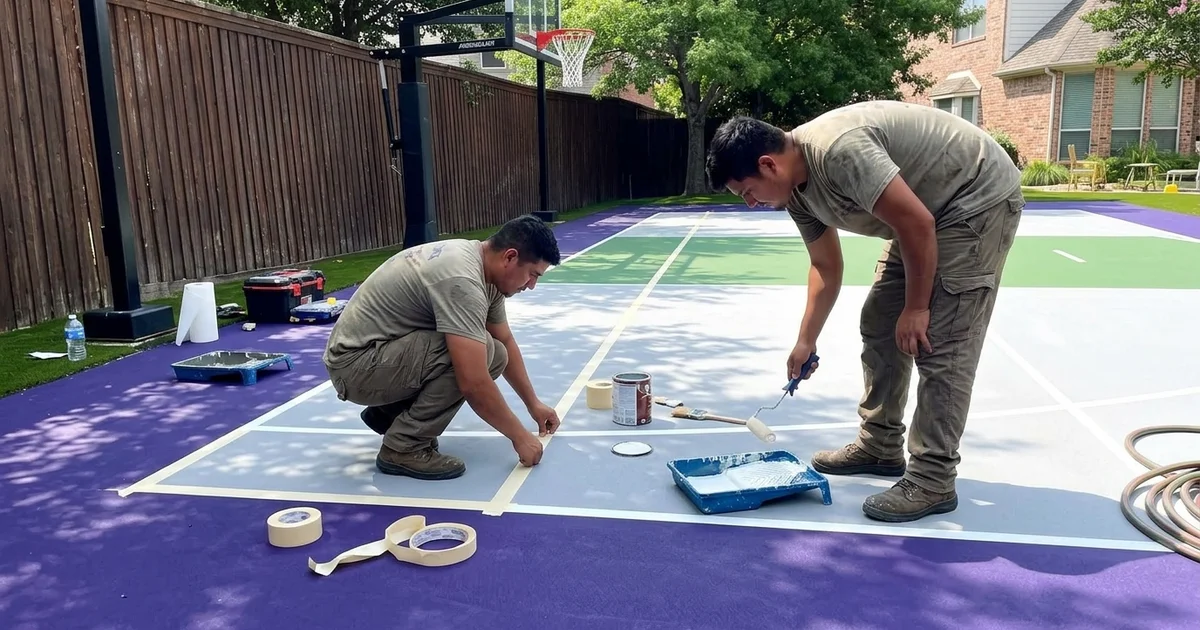
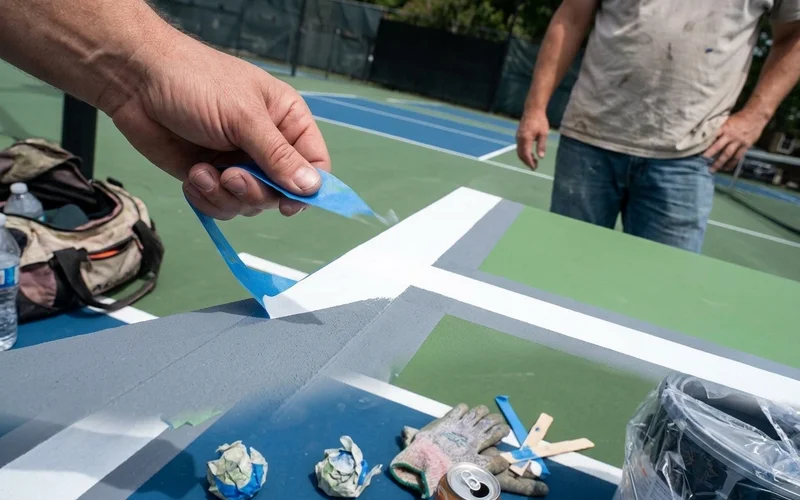
Where lines cross, the sequencing matters. The primary set goes down first, then the secondary is masked and painted over it in a way that keeps both readable at the intersection rather than producing a muddled overlap.
Contrasting keys and borders do the rest of the work. A basketball key in a different surface colour from the main playing area gives the eye an anchor, so even with two line sets present the court has visual structure.
Boundary Tolerances
Each sport has defined dimensions and defined tolerances, and a multi-sport layout has to respect all of them simultaneously.
That sounds obvious and it is where shortcuts happen. A pickleball court squeezed half a foot narrow to make it sit more neatly inside a basketball key is no longer a regulation pickleball court, and anyone who plays seriously notices.
We lay out each sport to its own correct dimensions first, then design the visual relationship between them. Where two sports genuinely cannot both sit correctly on a given pad, we say so at design stage rather than compromising one of them quietly.
Net Sleeves and Adjustable Systems
The hardware is what makes a multi-sport court practical day to day.
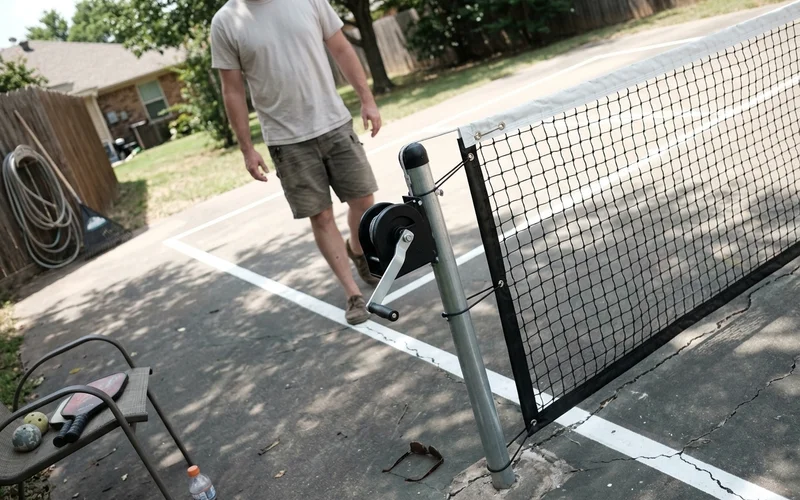
Dual-purpose net sleeves are cast into the slab during the original pour, set flush with the finished surface. Each has a cap that sits level when no net is in place, so there is nothing to catch a foot during basketball.
Height-adjustable multi-sport net systems drop straight into those sleeves. The same system sets to 34 inches at centre for pickleball or to volleyball height, using a crank or pin adjustment, with no tools required. Changeover takes well under a minute.
For basketball the net comes out entirely and the caps go back in.
Casting the sleeves during the pour is substantially better than core-drilling into cured concrete later. Cast sleeves are stronger, they sit perfectly flush, and unused ones cost almost nothing. If there is a sport you might want in three years, tell us at design stage and we will cast for it.
How the Striping Stage Runs
| Step | What happens |
|---|---|
| Layout | Chalk lines snapped for every sport to its own correct dimensions |
| Verification | Dimensions measured and checked against standards before any paint |
| Primary set | Masked and painted first, allowed to cure |
| Secondary set | Masked over the cured primary, painted, edges kept crisp |
| Keys and borders | Contrasting surface colours applied where specified |
| Final check | Every line measured again, edges inspected, touch-ups completed |
The whole stage takes a few days on a multi-sport court rather than the single day a simple layout needs. That extra time buys you edges that stay sharp where lines cross, which is exactly where a rushed job looks rushed.
Maintenance and Renewal
Acrylic line paint over a properly prepared surface is durable. It fades slowly with UV exposure and wears in the high-traffic zones, particularly around the service areas and under a basketball goal.
Lines are renewed as part of resurfacing, typically every six to ten years. That is also the natural moment to add a sport you did not originally stripe, or to change a colour scheme that has dated.
If you want to see the full build specification that sits under the line work, it is set out on our multi-sport court construction page.