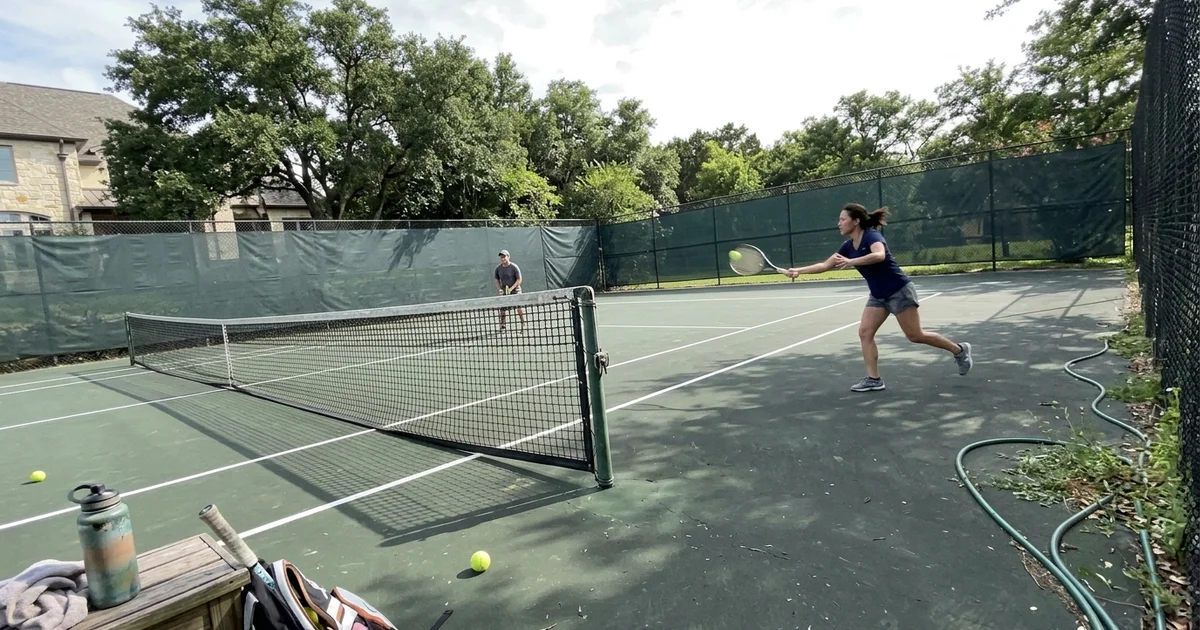
The Core Dimensions
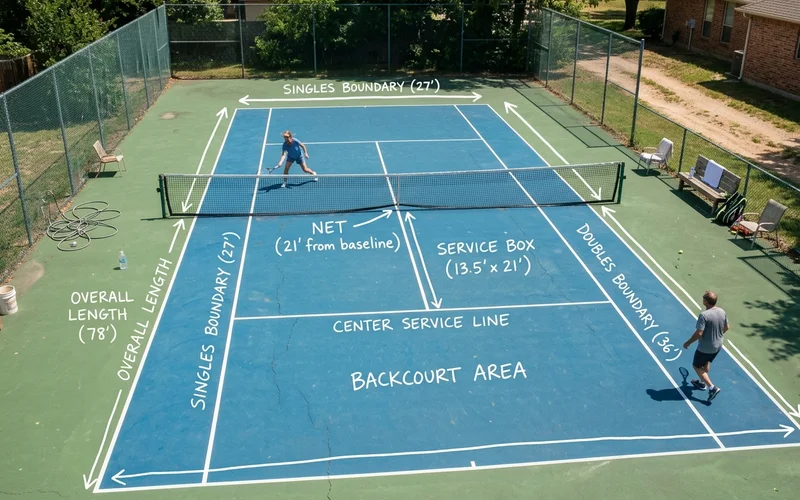
A regulation tennis court has a doubles playing area of 36 feet wide by 78 feet long. The singles court is narrower at 27 feet wide, using the inner sidelines, but the court itself is built to full doubles width with both lines marked.
Within that rectangle:
- Service boxes: 21 feet deep from the net on each side, divided down the middle by the centre service line
- Service line: runs across the court 21 feet from the net
- Baselines: the 36-foot lines at each end
- Doubles sidelines: the outer 78-foot lines
- Singles sidelines: 4 feet 6 inches inside each doubles sideline
- Centre mark: a short line bisecting each baseline
Line widths vary by which line: baselines can be up to 4 inches wide, other lines 2 inches. The outside edge of a line forms the boundary.
The Pad Is Far Bigger Than the Court
This is the number that determines whether a tennis court fits your property, and it is where most residential builds get compromised.
Tennis demands substantial run-off. Players chase deep balls well past the baseline and wide balls beyond the sideline, at speed. The standard residential pad is 60 feet by 120 feet, giving 21 feet behind each baseline and 12 feet along each sideline.
Twenty-one feet sounds generous until you watch someone retrieve a deep shot. It is not generous; it is the minimum that plays properly. Undersized surrounds are the most common shortcut on home courts, usually made to squeeze a court onto a lot that cannot really take one, and every player notices within the first game. Where a lot genuinely will not take a full pad, comparing a full-size versus a mini tennis court is the more honest exercise.
If a 60 by 120 pad genuinely will not fit, a well-proportioned mini court is a better outcome than a full court with cramped run-off. We build both, and we will say plainly which one your lot supports.
| Measurement | Dimension |
|---|---|
| Doubles playing area | 36 ft × 78 ft |
| Singles playing area | 27 ft × 78 ft |
| Recommended pad | 60 ft × 120 ft |
| Run-off behind baseline | 21 ft |
| Run-off beside sideline | 12 ft |
| Service box depth | 21 ft from net |
| Net height at posts | 42 inches |
| Net height at centre | 36 inches |
Net Heights and Hardware
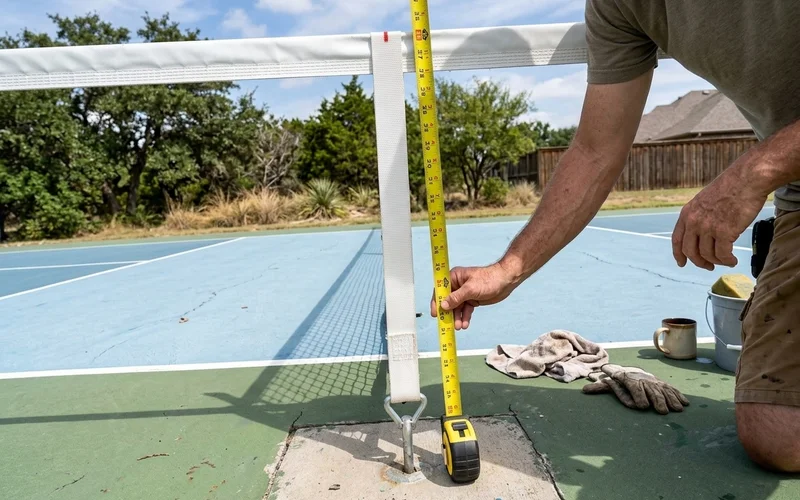
A tennis net is 42 inches high at the posts and 36 inches at the centre, and that six-inch difference is held by a centre strap anchored into the court surface.
Without the strap, a tensioned net sags unpredictably and the centre height drifts upward as the cable stretches. The anchor is set flush into the slab, which is far better done during the original pour than core-drilled afterwards.
Posts are tensioned with a turnbuckle cable tensioner rather than a simple crank, because a tennis net carries considerably more tension than a pickleball net and needs hardware that will hold it across a season without slipping.
Cross-Slope: The Specification That Decides Drainage
A tennis court is the largest slab we pour, which makes drainage more consequential than on any other court.
The standard is a continuous cross-slope of 1:120, roughly one inch of fall for every ten feet, running as a single unbroken plane across the whole court. That is enough to shed water in minutes without affecting how the ball behaves on either side of the net.
The fault we see on older courts is a slope that runs side to side from the net in both directions, which leaves water sitting along the net line after every storm. It is difficult and expensive to correct once the slab is cured, which is why the fall gets set with string lines before the forms go in on every court in our tennis court construction work.
Fencing and the Total Footprint
Ten-foot perimeter fencing is standard for tennis because lobs carry. Windbreak screens on the fence cut the North Texas wind that otherwise makes a ball unpredictable, and they add privacy.
Two things worth planning for. Fencing sits outside the pad, so the total installed footprint is larger than 60 by 120 and that is what has to clear your setbacks. And windscreens should have blowout vents; solid mesh acts like a sail and North Texas gust fronts regularly take those fences down.
Orientation
Not a dimension, but it belongs in any planning conversation. A north-south alignment keeps the low morning and evening sun out of players’ eyes along the length of the court, which is exactly when most home courts get used.
Where lot geometry makes a perfect north-south orientation impossible, it is worth understanding the trade-off before the court is placed rather than after.