The Honest Framing
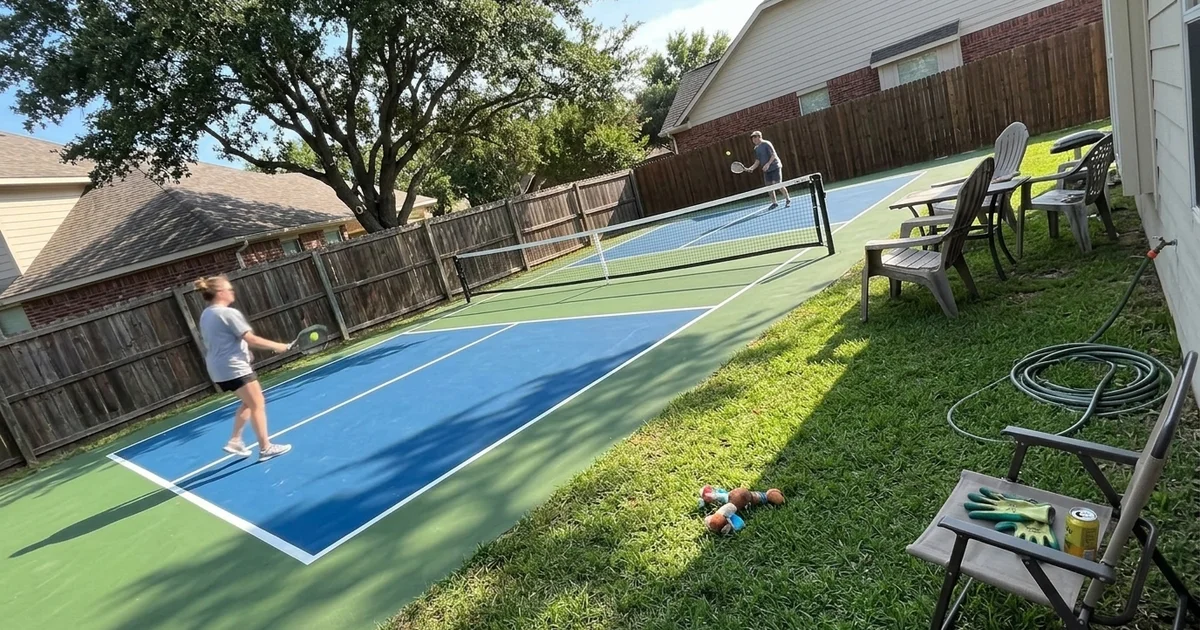
Tennis is the one sport where residential builds most often get compromised, because the footprint it genuinely needs is large and a lot of properties are not quite there.
A full-size court requires a 60 by 120 foot pad. Twenty-one feet of run-off behind each baseline, twelve along each sideline. That is not a luxury allowance, it is the space players actually use, and courts built with less of it feel wrong from the first deep rally. The full breakdown of regulation tennis court dimensions and space requirements shows where each of those figures comes from.
So the real choice is not between a big court and a small court. It is between a full-size court on a property that supports it, and a well-proportioned mini court on one that does not.
What a Full-Size Court Gives You
Genuine tennis. Singles, doubles, coaching, and match play with proper run-off, built to the ITF and USTA construction standards we follow on all tennis court construction.
It is also the largest slab we pour, which has consequences worth knowing. More concrete, more surface area, and therefore more cost both to build and to resurface every six to ten years. It typically consumes the entire usable backyard on a standard suburban lot, and it needs serious access for concrete delivery.
On acreage properties in Prosper, Southlake, Colleyville, and the larger Flower Mound and McKinney estates, all of that is manageable and a full court is a wonderful thing to own.
What a Mini Court Gives You
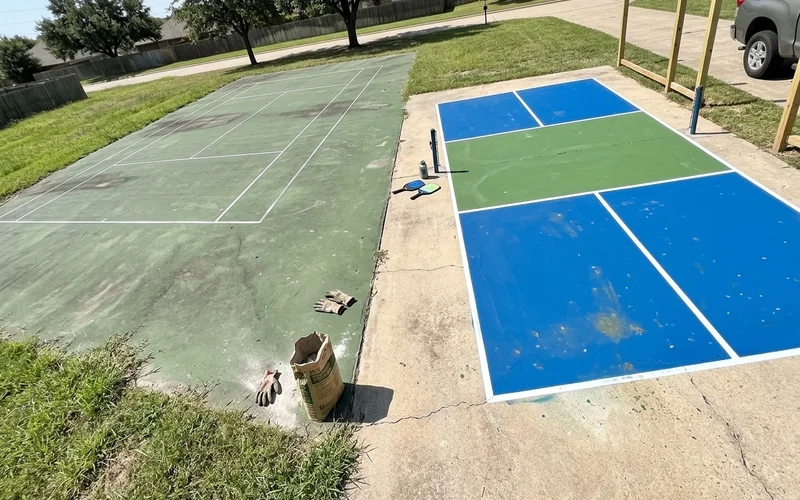
A proportionally reduced layout that plays properly for rallying, drills, serve practice, and junior tennis.
The value here is underrated. A large share of the hours anyone actually spends on a tennis court are practice hours, not match hours. Groundstroke rallying, volley work, and serve placement all happen on a fraction of the full footprint. For a family with juniors developing, a mini court can deliver more usable practice time than a full court that had to be squeezed in awkwardly.
It also costs meaningfully less, because slab and surface area are the dominant cost components and both scale directly. And it leaves room in the yard for everything else a backyard needs to do.
Side by Side
| Factor | Full-size court | Mini court |
|---|---|---|
| Pad required | 60 × 120 ft | Considerably less |
| Lot type | Acreage | Standard suburban possible |
| Supports | Singles, doubles, match play | Rallying, drills, juniors |
| Relative cost | Highest of anything we build | Substantially lower |
| Resurfacing cost | Highest | Lower, same cycle |
| Leaves garden space | Usually no | Usually yes |
| Fencing perimeter | Large | Smaller |
When Multi-Sport Is the Better Answer
This deserves saying plainly, because it is the recommendation we make most often to people who came in asking about tennis.
If tennis is one of several sports your household wants rather than the clear priority, a multi-sport court almost always delivers more. A single pad striped for pickleball and basketball costs less than a full tennis court, fits a normal suburban lot, and gets used by more people more often.
Tennis is the one sport that does not combine well on a shared pad, because its footprint dwarfs everything else. If you build a 60 by 120 court and stripe pickleball on it, that works well. If you try to make a smaller multi-sport pad serve tennis too, it does not.
So the honest sequence is: if tennis is the priority and the lot supports it, build a full court and stripe pickleball on it as a bonus. If tennis is one of several wants, look at multi-sport courts instead.
How to Decide
Three questions settle it.
Does the lot genuinely take 60 by 120 plus fencing, inside your setbacks? If not, a full-size court is off the table regardless of preference, and a squeezed one will disappoint.
What proportion of use will be match play versus practice? If it is mostly practice and juniors, a mini court delivers nearly all the value for a fraction of the cost and space.
Is tennis the priority or one of several sports? If it is one of several, multi-sport is the better use of the money.
Whichever way it lands, the engineering is identical: an engineered post-tension slab, a continuous cross-slope drainage plane, and a full 100% acrylic system. You can see the specification behind both options on our tennis court construction page, and the free on-site measurement will tell you definitively which one your property supports.