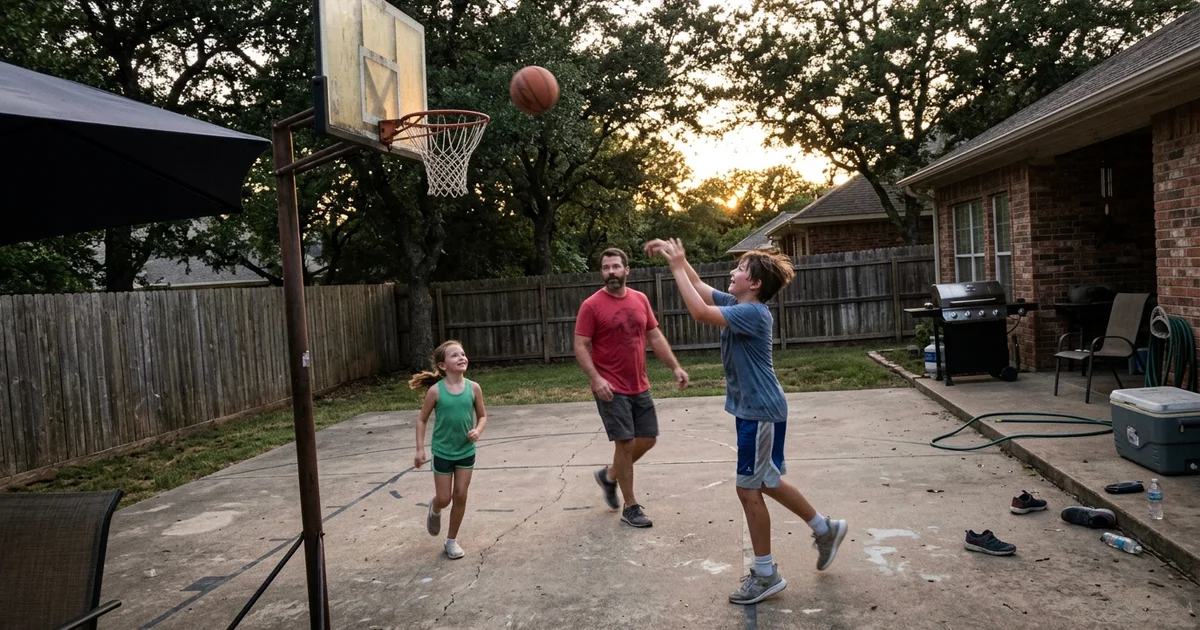
The Decision Is About Use, Not Ambition
Almost everyone starts this conversation wanting the full court. Almost everyone who builds the right-sized court ends up happier.
That is not us talking people down to save work. It comes from watching what happens to 325-plus courts after we leave. The courts that get used every evening are consistently the ones sized honestly to the property and to who actually plays on them.
So the useful question is not “which is better”. It is “what will genuinely happen on this court in a normal week”. If you are still weighing the layouts themselves, the basketball court size options set out what each footprint delivers.
What a Half Court Gives You
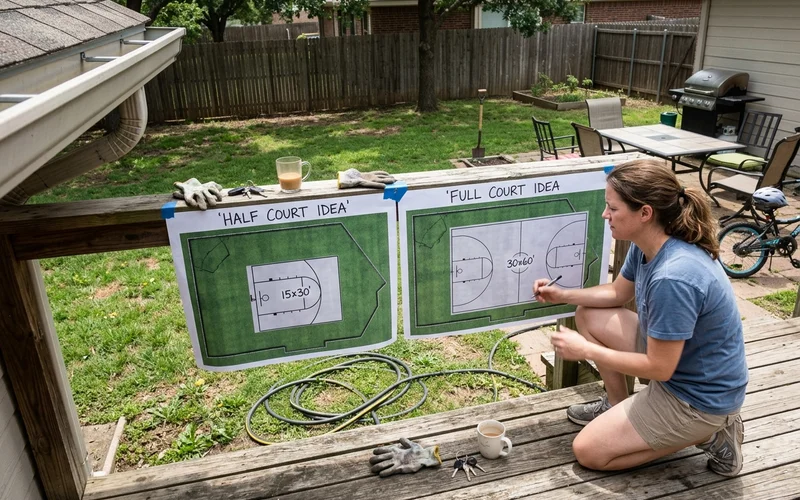
A backyard half court, typically around 30 by 50 feet, delivers a proper key, a free-throw line, and a full 3-point arc against a single goal.
On it you can run shooting practice, free-throw routines, one-on-one, two-on-two, three-on-three, and pretty much every drill a coach would assign. For a household with kids playing school basketball, that covers close to everything.
What it does not support is five-on-five with a transition game, or full-court drills that need both ends.
What a Full Court Gives You
A high school full court is 50 by 84 feet; an NBA-size court is 50 by 94 feet. Two goals, two keys, and the full length.
The thing a full court actually adds is transition. Running the floor, fast breaks, full-court press drills, and genuine five-on-five games. If you have a player training seriously, or you host regular pickup games with adults, that is a meaningful difference rather than a cosmetic one.
It also needs genuine acreage. On most DFW suburban lots, a full court consumes the entire usable backyard, and that trade-off deserves a hard look before you commit.
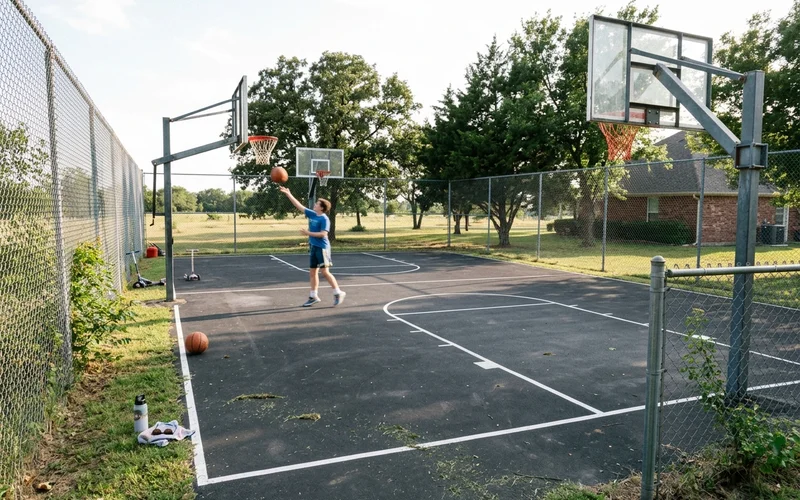
Side by Side
| Factor | Half court | Full court |
|---|---|---|
| Typical pad | ~30 × 50 ft | 50 × 84 to 50 × 94 ft |
| Goals | 1 | 2 |
| Supports | Shooting, 1v1, 3v3, drills | All of that plus 5v5 and transition |
| Relative cost | Baseline | Roughly double to triple |
| Lot required | Standard suburban backyard | Acreage |
| Leaves room for garden | Usually yes | Usually no |
| Lighting cost | Fewer poles | More poles, wider coverage |
| Maintenance | Smaller surface to resurface | Larger surface, higher renewal cost |
The Cost Conversation, Honestly
The cost difference is not proportional to the enjoyment difference for most households.
Slab and surfacing scale directly with area, and a full court is two to three times the footprint of a typical backyard half court. Add a second goal system with its own concrete footing, more fencing perimeter if you enclose it, and more lighting poles if you light it.
For many families, the money saved by building a half court instead pays for the lighting, the fencing, and the pickleball striping that turn a court into something used most evenings rather than most weekends. That is usually a better outcome than a larger, plainer court.
The Middle Option Worth Knowing
A three-quarter court is a genuine alternative that rarely gets mentioned. Full width, shortened length, one or two goals depending on configuration.
It supports a partial transition game, which is the main thing a half court lacks, while using substantially less space than a full court. It suits lots that are wide but not deep, which is a very common shape in North Texas subdivisions.
How We Would Decide
Three questions, in this order.
Who plays, and how often? If the honest answer is one or two kids shooting after school plus occasional family games, build a half court and spend the difference on lighting so it gets used after sunset.
Do you need the rest of the yard? If a full court would leave nowhere for a lawn, seating, or planting, it will cost you more than money.
Is there a serious player in the house? If someone is training with real intent and needs full-court work, and the lot supports it, a full court earns its footprint.
Whichever way it goes, the engineering underneath is identical: an engineered post-tension slab, a continuous drainage plane, and a 100% acrylic surface with regulation striping. You can see the full specification on our basketball court construction page.
And whichever size you pick, consider adding pickleball striping. It costs very little on a pad you are already pouring and it roughly doubles how often the court gets used.