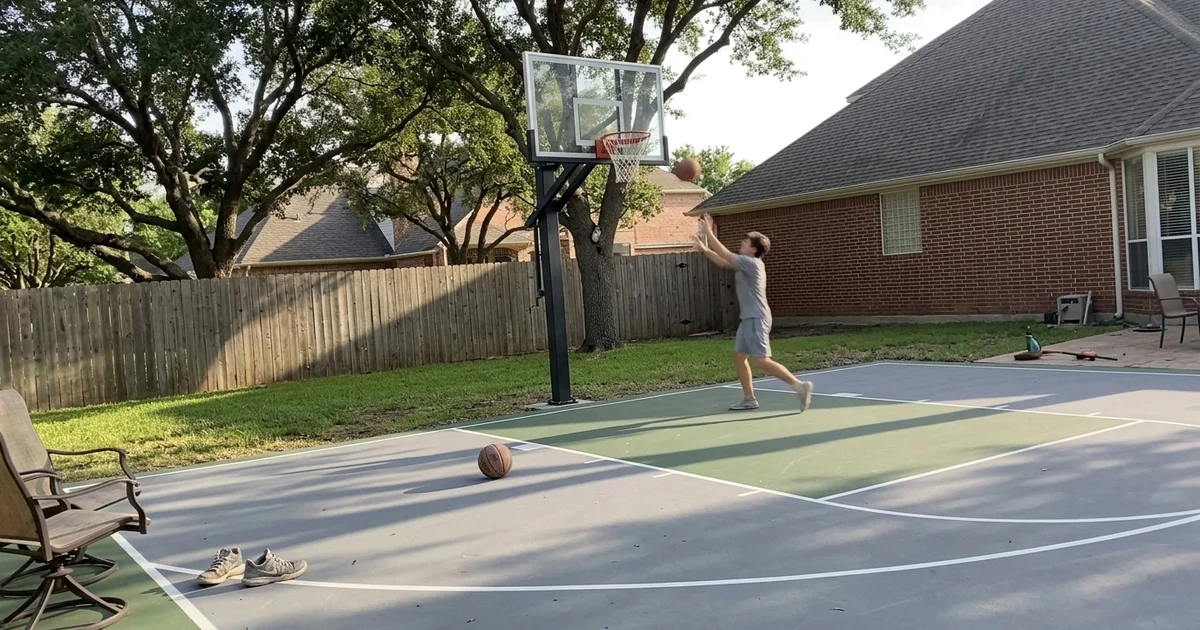
Three Sizes, Three Different Games
Backyard basketball is unusually flexible compared with other sports, because there is no fixed boundary you must respect. A pickleball court is 20 by 44 feet or it is not a pickleball court. A basketball court can be almost any size and still be a good basketball court.
That freedom is useful, and it also means the size decision is genuinely yours to make. Here are the three practical options.
Mini court. From around 20 by 30 feet. A goal, a key, and enough room to shoot and rebound. This is not a compromise so much as a different product: it is a shooting and skills space rather than a game space, and it fits yards where anything larger would swallow the garden.
Half court. Around 30 by 50 feet for a typical backyard build, or roughly 50 by 42 feet for a true regulation half. You get a proper key, a free-throw line, and a full 3-point arc. One-on-one, three-on-three, and serious shooting practice all work. This is the sweet spot for most DFW properties.
Full court. 50 by 84 feet at high school dimensions, or 50 by 94 feet at NCAA and NBA size. Two goals, a transition game, and genuine five-on-five. It needs real acreage, and we build them regularly on the larger lots in Prosper, Southlake, and Colleyville. Deciding between the middle two comes down to half court vs. full court and what actually gets played in a normal week.
The Markings That Matter
Whatever size you build, the line work has to be right or the court never feels correct to play on.
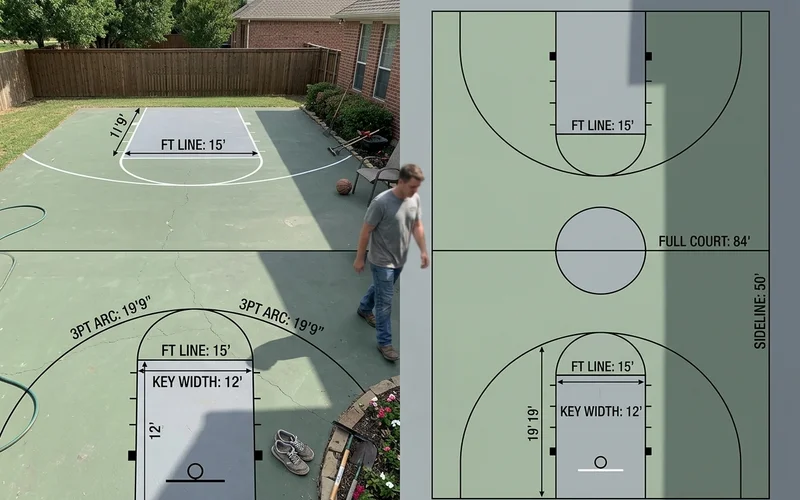
The key, or lane. 16 feet wide at high school level and above, extending 19 feet from the baseline to the free-throw line. The free-throw line position is what makes practice meaningful, so it is worth getting exactly right even on a smaller pad.
The 3-point arc. This is the one that varies by level. High school is 19 feet 9 inches from the centre of the basket. College and professional arcs are further out. We stripe to whichever standard matches how the court will be used, and on a family court the high school arc is usually the right call.
The baseline and sidelines. On a half court these define the playing area. On a mini court they are often notional, since the pad edge does the same job.
A contrasting key colour is a small choice that makes a large visual difference, and it reads clearly on video, which matters more than it used to now that everyone films their kids playing.
Overhead Clearance: The Constraint People Forget
Ground footprint gets all the attention. Vertical clearance gets none, and it is the one thing that cannot be fixed after the court is built.
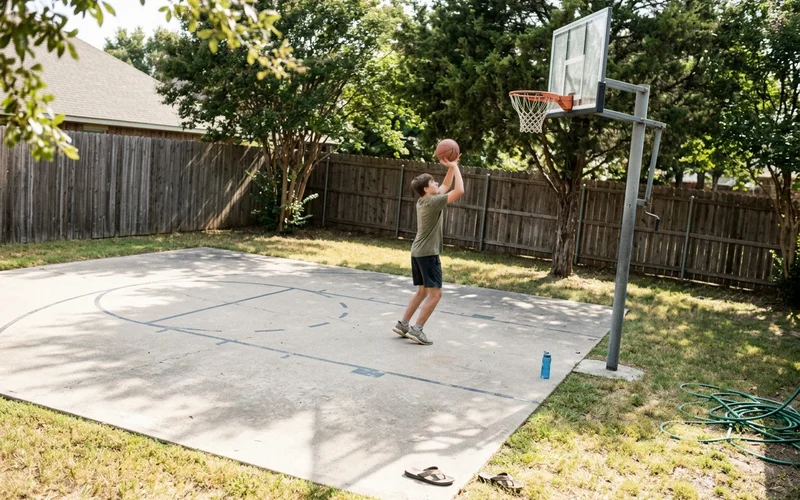
You need clear air above the goal area for the shooting arc, and clearance beyond the pole for the backboard’s overhang. Tree limbs, roof eaves, second-storey balconies, and overhead power lines all matter here.
We check clearance during the on-site visit and, where a tree limb is the issue, we will usually recommend moving the goal a few feet rather than removing a mature tree. It is worth raising early, because a court placed under a canopy also drops leaves onto the surface year-round.
Quick Comparison
| Layout | Typical pad | Goals | Best for |
|---|---|---|---|
| Mini | From ~20 × 30 ft | 1 | Shooting, skills, tight yards |
| Half court | ~30 × 50 ft typical | 1 | Family play, 1v1, 3v3 |
| Regulation half | ~50 × 42 ft | 1 | Serious practice, larger lots |
| Full court (HS) | 50 × 84 ft | 2 | Five-on-five, acreage lots |
| Full court (NBA) | 50 × 94 ft | 2 | Maximum, acreage lots |
How to Choose
Two questions decide it, and neither is about the size of your yard.
Who plays, and how? If it is mostly one or two kids shooting after school, a mini or half court gets used every day. If you regularly host five-a-side with adults, a half court will frustrate everyone within a month.
What else does the yard need to do? A full court on a lot that could take it, but that also needs to hold a pool, a lawn, and a seating area, may not be the best use of the space. We have talked plenty of people down a size and none of them have come back regretting it.
The honest observation from 325-plus courts: the ones that get used most are the ones sized to the property rather than to the aspiration. A well-proportioned half court with generous run-off beats a cramped full court every time.
Worth knowing too: adding pickleball striping to a basketball pad costs very little and turns one court into two games. Plenty of our basketball court construction customers end up on a multi-sport layout for exactly that reason.