Why Lighting Changes How Much a Court Gets Used
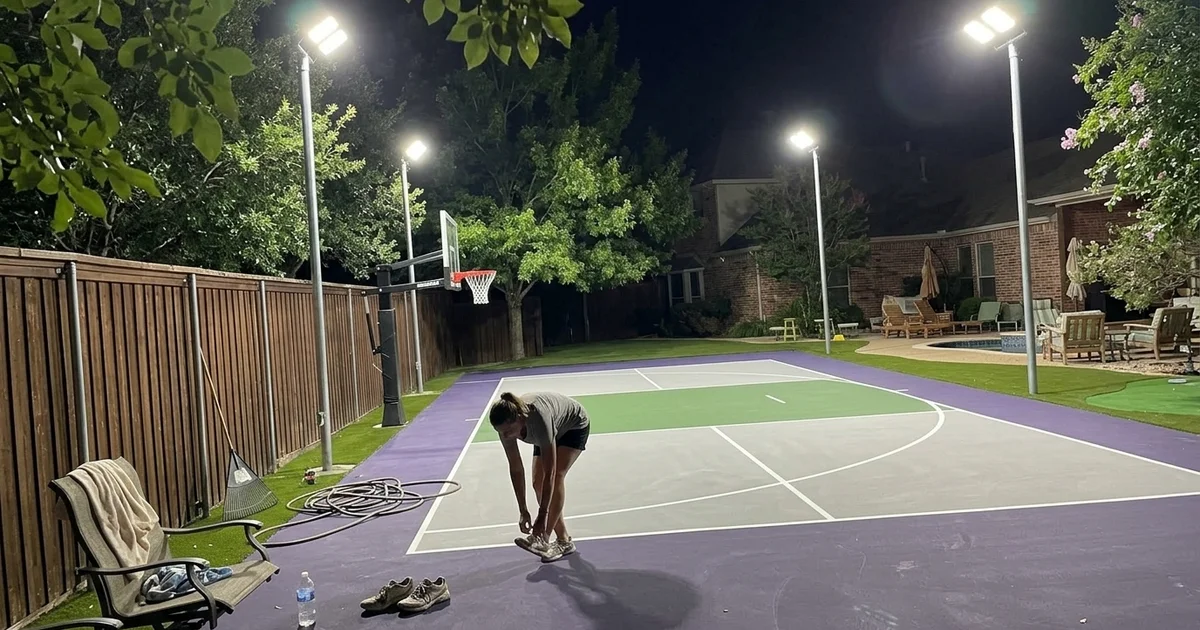
In a North Texas summer, an unlit court gives you roughly two comfortable hours a day: early morning before it heats up, and the short window after sunset before it is too dark to see.
Lighting turns that into a full evening. For most households it is the single upgrade that most changes whether a court is used regularly or occasionally, and it is why we raise it on nearly every build even when it is not in the original brief.
The design challenge is putting light on the court and nowhere else. Evening play also makes sound carry further, so lighting is worth planning alongside reducing pickleball noise with sound barriers.
LED Floodlights and Forward-Throw Optics
Court lighting has changed substantially with LED technology, and the important improvement is not efficiency, it is control.
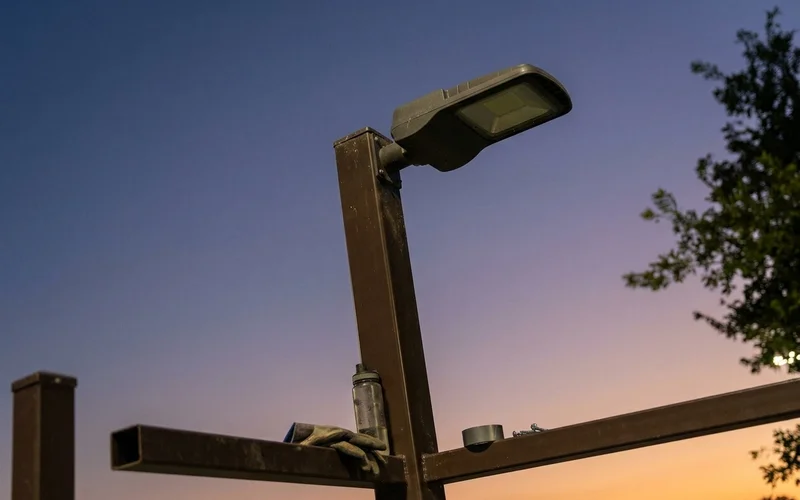
Older metal halide fixtures threw light broadly and relied on physical shielding to limit where it went. Forward-throw optical distribution in modern LED luminaires shapes the beam at the source, pushing light down and forward onto the playing surface in a controlled pattern rather than scattering it in every direction.
That control is what makes the difference between a court you can light without argument and one that generates complaints from the house behind you.
Dark-sky compliant luminaires take it further with full cut-off optics that emit no light above the horizontal. That meets local dark-sky ordinances where they exist, and it is increasingly what HOA committees expect regardless.
Zero Spillage at the Property Line
This is the design target and it is measurable rather than aspirational.
Light levels are expressed in footcandles, and the specification we work to is zero footcandles at the property boundary. That means all the useful light lands on the court and effectively none crosses into a neighbour’s yard.
Achieving it takes three things: the right fixture optics, correct pole placement, and correct aiming.
We produce a photometric plan before installation showing predicted light levels across the court and at the boundary. Then, after the fixtures are up, we come back at night, run them, and adjust the aiming against what we actually see rather than what the plan predicted.
That night visit is not standard practice in the industry. It should be, because a fixture aimed two degrees off in a plan is a fixture shining into a bedroom window in reality.
Pole Height and Placement
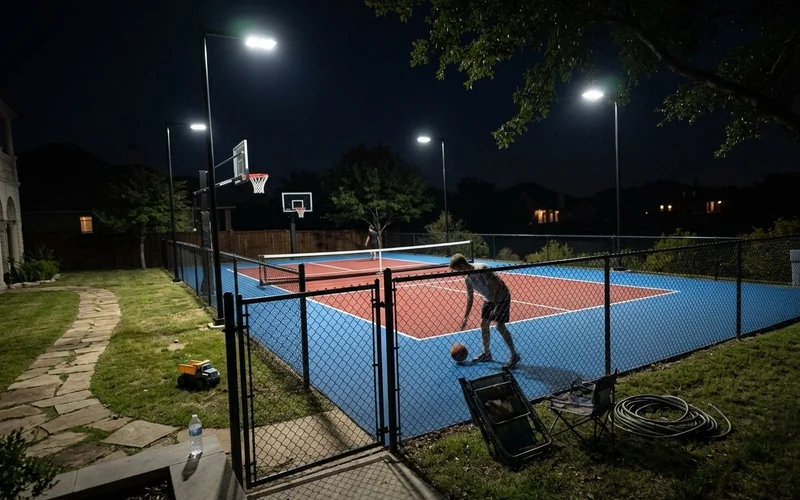
Pole height is a balance. Too short and you get hot spots directly beneath each fixture, dark areas between them, and glare in players’ eyes at the horizontal. Too tall and you are drawing unnecessary attention in an HOA application and spending more on structure than you need to.
Around twenty feet is typical for a residential court, adjusted for court size and fixture optics.
Placement matters as much as height. Poles are positioned to light the playing area evenly without any fixture sitting in a player’s eyeline during normal play, which generally means off the sidelines rather than behind the baselines.
Every pole sits on an engineered concrete footing, sized for wind loading. Galvanized steel lighting poles handle North Texas weather and do not need repainting.
What It Takes to Get Approved
Lighting is the most scrutinised element of any residential court application in DFW, and applications fail for a predictable reason: no evidence.
A photometric plan showing coverage and boundary spill, pole heights, and fixture specifications is what a committee needs to say yes. A manufacturer’s brochure and an assurance is what gets an application deferred to the next meeting.
We produce that documentation as part of the project and submit it with the HOA packet, which is why our lighting applications generally clear on the first review.
| Element | What we specify |
|---|---|
| Fixture type | Forward-throw LED, dark-sky compliant full cut-off |
| Boundary target | Zero footcandles at the property line |
| Pole height | Typically ~20 ft, sized to the court |
| Pole material | Galvanised steel on engineered footings |
| Documentation | Photometric plan for HOA and city review |
| Commissioning | Night visit to verify and adjust aiming |
Install It With the Court
Every part of a lighting installation is cheaper while the ground is open.
Conduit runs, pole footings, and any electrical routing all happen far more easily during construction than as a retrofit around a finished slab and established landscaping.
If you are building now and undecided about lighting, the cheapest hedge is to run the conduit and set the pole footings during construction, then add the luminaires whenever you are ready. The rough-in is a small share of the total and it removes the expensive part of the decision from future you.
You can see the full lighting and enclosure scope on our court lighting and fencing page.