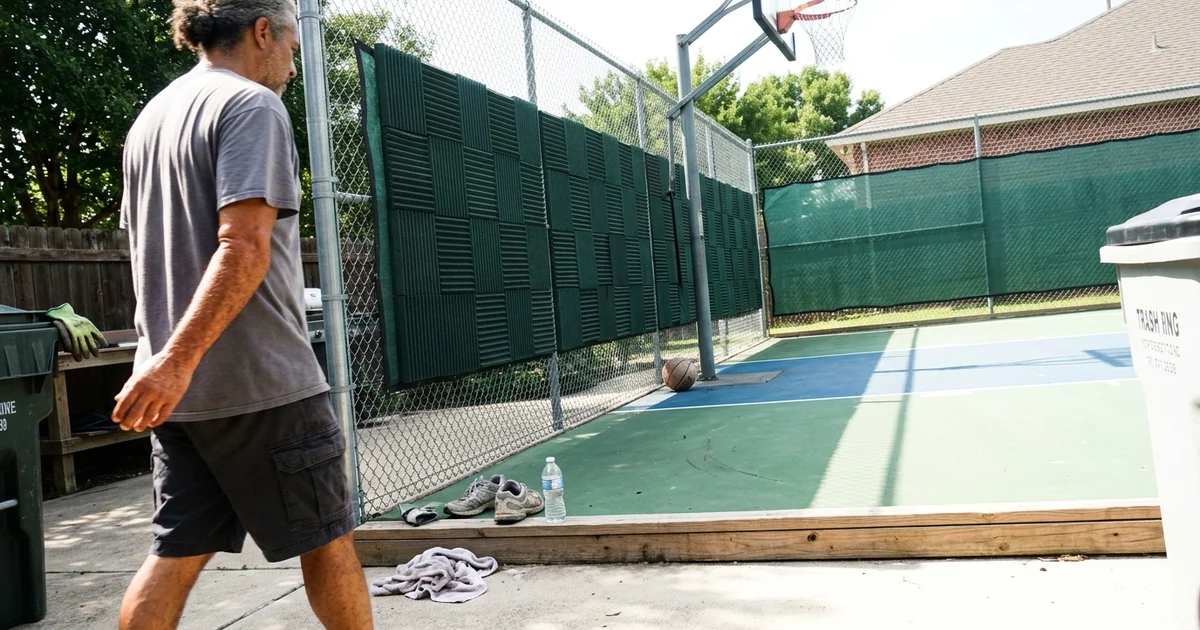
Why Pickleball Noise Is Different
Tennis has been played in backyards for decades without generating the complaints pickleball does. The difference is acoustic rather than social.
A pickleball paddle striking a hard plastic ball produces a sharp, high-frequency impulse sound. Hard-surfaced, short in duration, and repeated every second or two during a rally. That combination carries further than the duller thud of a tennis ball on strings, and human hearing is particularly good at picking out exactly that kind of sound against background noise.
It is also repetitive in a way that draws attention. A neighbour who never noticed tennis will notice pickleball, and that is not unreasonable of them.
The good news is that it is a solvable design problem, and the solutions are inexpensive if they are planned rather than retrofitted — the same is true of court lighting for night play, the other neighbour-facing decision worth settling at design stage.
Orientation Comes First and Costs Nothing
The single most effective intervention is where the court faces, and it is free at design stage.
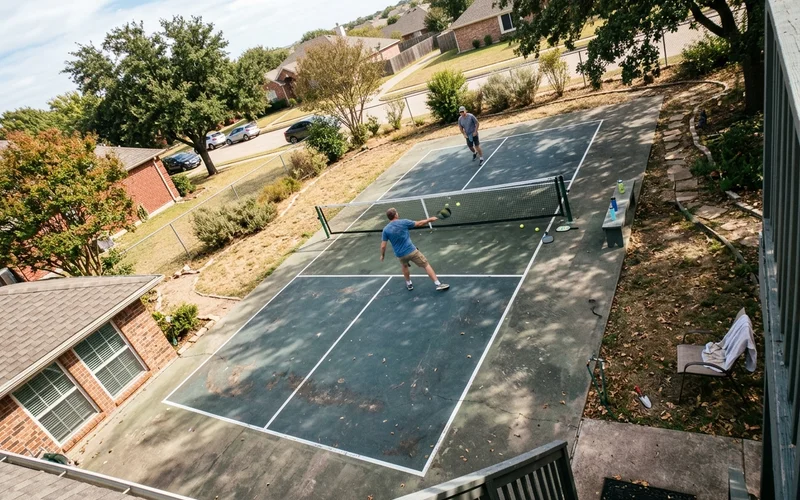
Paddle strike is directional. The sound projects most strongly perpendicular to the net, along the line of play. Rotating a court so that dominant direction points away from the nearest homes, rather than straight at them, makes a genuine difference.
We plan this during the 3D design stage on every pickleball project, mapping the court against the position of neighbouring houses rather than simply squaring it to the fence line.
It is also impossible to change after the concrete is poured, which is why it belongs in the first conversation rather than the fifth.
Acoustic Barrier Fabric
The second intervention is treating the fence runs that face the nearest homes.
Acoustic barrier fabric is a dense, mass-loaded material fitted to the fence that absorbs sound energy rather than reflecting it. Standard fence fabric and windscreen mesh do very little acoustically; acoustic barrier material is specifically engineered for it.
Two practical points. It works on the runs where it is fitted, so we specify it for the boundaries facing neighbours rather than wrapping the whole perimeter, which is both cheaper and more honest about what it achieves. And it adds wind load to the fence, so posts need to be sized accordingly.
It will not make a court silent. What it does is reduce what carries to the specific properties where it matters, and combined with orientation and setback that is usually the difference between a court nobody minds and one that generates a complaint.
HDPE Windscreens
Windscreens serve a different primary purpose and contribute modestly to the acoustic result.
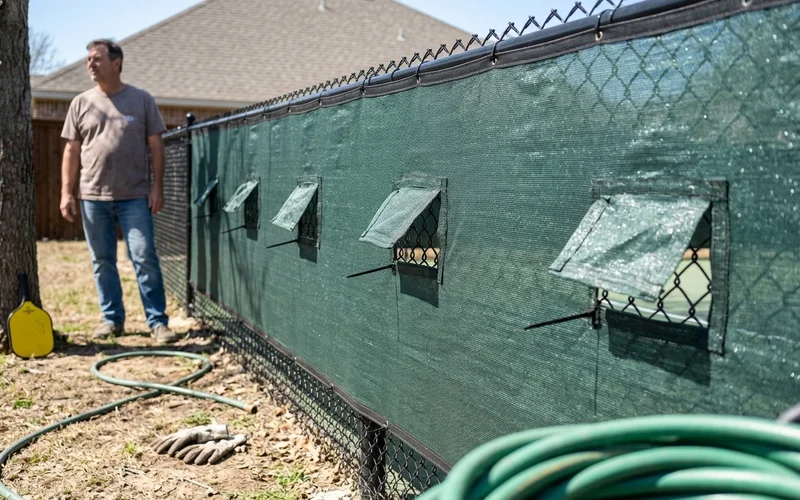
HDPE windscreens cut the North Texas wind that otherwise makes a pickleball unpredictable, and they add privacy. They also provide a small amount of additional mass on the fence line.
The specification detail that matters is blowout vents. Solid mesh acts like a sail, and North Texas gust fronts regularly take fences down when the screen has nowhere to relieve pressure. Vented HDPE screens let the wind through under load instead of transferring it into the posts.
Setback Distance
Sound attenuates with distance, and this is why acreage properties in Prosper, Colleyville, and Southlake rarely have noise problems while tight suburban lots sometimes do.
Where a site offers a choice of locations, putting the court in the corner furthest from neighbouring houses is worth more than any treatment you can buy. It is another reason the location decision deserves attention before the design is fixed.
| Intervention | Effectiveness | Cost | When to decide |
|---|---|---|---|
| Court orientation | High | Free | Design stage only |
| Setback distance | High | Free if the site allows | Design stage only |
| Acoustic barrier fabric | Moderate to high | Modest | Design or retrofit |
| HDPE windscreens | Low acoustically | Modest | Design or retrofit |
| Quieter paddles | Moderate | Low | Anytime, but uncontrollable |
Equipment and Ordinances
Quieter paddles and balls are a real category and they genuinely reduce strike volume. The limitation is control: you cannot dictate what equipment a guest brings. Treating the court works regardless of who is playing, which is why we focus there and treat equipment as a helpful extra.
On ordinances, a growing number of DFW jurisdictions and associations now address court noise directly, through setback requirements, operating hour limits, or mandated mitigation. We design to comply and include the acoustic approach in the HOA and permit submission rather than waiting to be asked.
That last point matters more than it sounds. A committee reviewing an application that has already anticipated the noise question is considerably more comfortable approving it than one being asked to take a risk.
You can see the full enclosure and acoustic scope on our court lighting and fencing page, and the design approach on our pickleball court construction page.