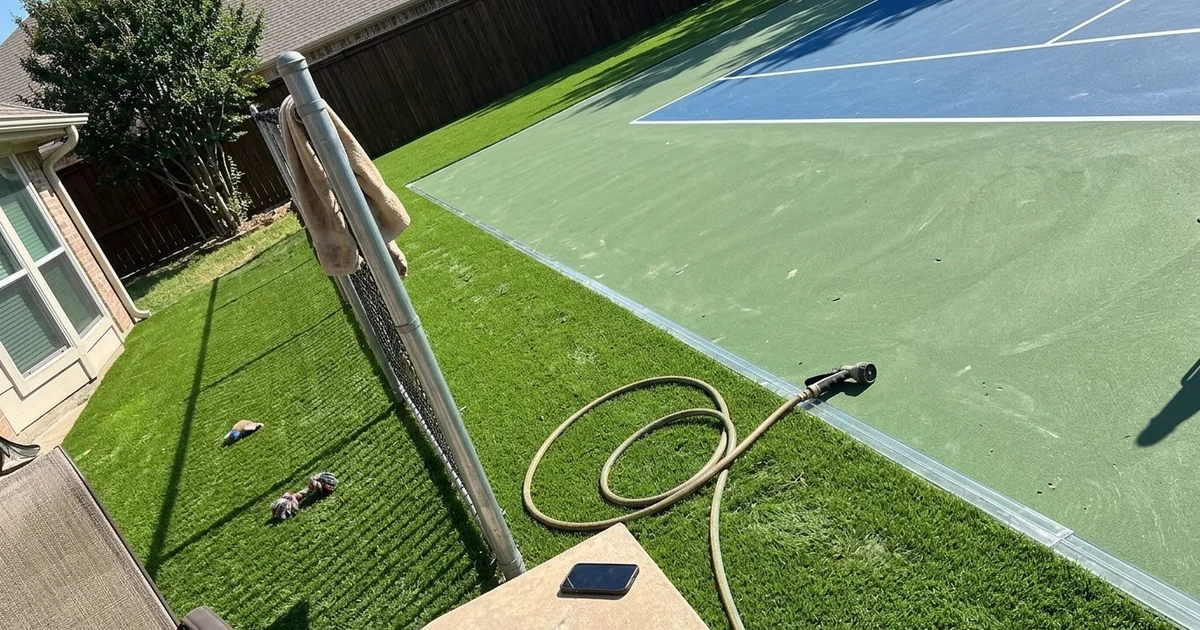
The Strip Around a Court Is Where Lawns Give Up
Anyone who has built a backyard court knows what happens to the grass immediately around it. Constant foot traffic compacts it, it never recovers, and after the first wet spring it becomes a mud ring that gets tracked onto the playing surface and into the house.
Artificial turf solves that permanently. It also does something less obvious but equally valuable: a clean turf surround with proper edging is what makes a court read as part of a designed backyard rather than a slab dropped into a lawn.
Most of what determines whether a turf installation works is invisible once it is finished — chiefly drainage, which is the same reason water pools on a court when the surround is wrong.
Border Versus Integration
Two approaches, and the distinction matters.
Border surround. Turf runs up to the court pad edge, separated by permanent landscape edging. This is the right approach and the one we recommend. You get a soft run-off area, a clean visual transition, and no compromise to the playing surface.
Integration into the playing area. Turf incorporated into the court surface itself. We do not do this, and we would advise against it. Acrylic and turf behave completely differently underfoot, and the transition between them mid-rally is a genuine trip risk. The visual idea is appealing; the practical result is not.
The border approach also scales. Plenty of projects start as a narrow surround and end up covering a wider play area or the whole rear garden, which is simply more of the same installation.
Drainage Is the Whole Job
This is where turf installations succeed or fail, and it happens before any turf is unrolled.
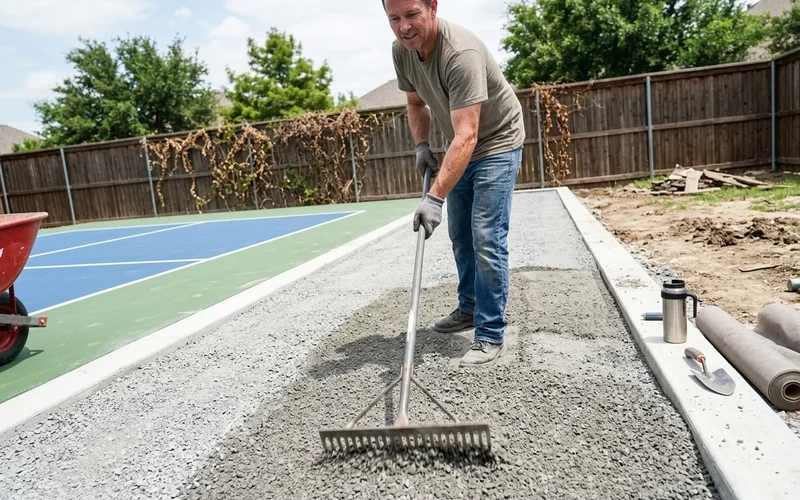
We excavate the area, remove existing surface and organic material, then lay and compact a crushed aggregate sub-base to a specified depth. That base is what actually handles water. The turf sits on top of it.
The turf itself uses perforated polyurethane backing, so water passes through rather than being held above it. Together, base and backing deliver a specified dynamic drainage flow rate, meaning a measurable volume of water per hour the installation can handle.
The shortcut that ruins synthetic grass is laying turf straight onto compacted clay. Water has nowhere to go, it sits under the backing, the area develops an odour within a season, and the surface settles unevenly. In Blackland Prairie clay specifically, this is not a marginal issue.
Fibre Type and Infill
Fibre. We use polyethylene monofilament fibers, which hold colour and stay soft under prolonged UV exposure. Cheaper polypropylene products go brittle and fade noticeably after two or three Texas summers, which is the difference between turf that lasts five years and turf that lasts fifteen to twenty.
Infill. The material brushed down into the fibres does two jobs: it keeps the pile standing upright and it weights the turf down. Antimicrobial infill options, silica or Envirofill types, manage odour rather than absorbing it, which matters anywhere dogs use the space.
The right infill depends on use. A pure court surround wants something that keeps a dense pile upright under foot traffic. A pet area wants antimicrobial. A play area benefits from a softer option.
Seams and Edging
Two finishing details separate a professional installation from an obvious one.
Seams. Where turf rolls meet, they are joined with seam turf adhesive and seaming tape, with fibre direction matched so the join disappears. A visible seam running across a lawn is the most common giveaway of a rushed installation.
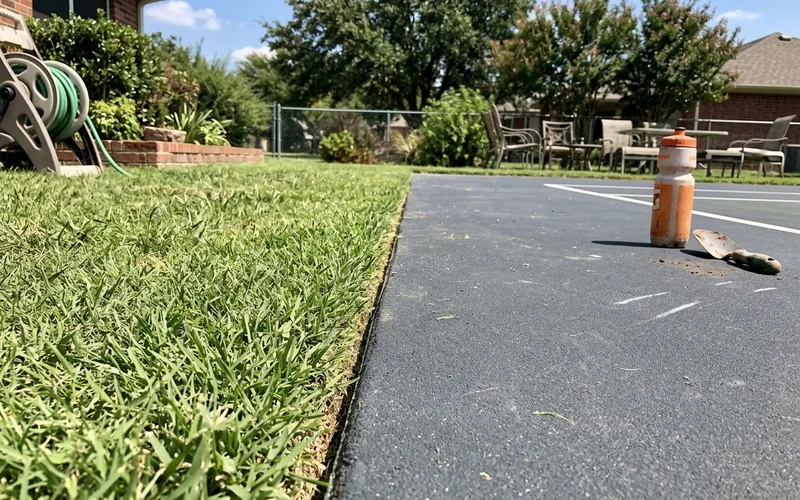
Edging. Border landscape edging gives a permanent, straight line where turf meets the court pad, a path, or a planting bed. Without it, turf edges lift, fray, and creep over the court surface. With it, the transition stays crisp for the life of the installation.
| Layer | Purpose |
|---|---|
| Excavation | Remove organic material, set levels |
| Crushed aggregate sub-base | Bearing support and drainage capacity |
| Perforated backing | Lets water through to the base |
| Polyethylene monofilament fibres | UV-stable, colour-fast wearing surface |
| Antimicrobial infill | Keeps pile upright, manages odour |
| Border landscape edging | Permanent clean transition |
The Maintenance Payoff
No mowing, no watering, no fertiliser, no reseeding patches that never take, and no mud tracked into the house after a storm.
The actual routine is minimal: rinse occasionally to keep dust down, brush the high-traffic paths every few months so fibres stand back up, and clear leaves before they break down into the pile.
The best time to install turf is alongside the court build, because excavation, levels, and drainage planning overlap. You can read about the full installation process on our artificial turf installation page, and about the courts it surrounds on our pickleball court construction page.